Can You Boost a Starlink T-Satellite Signal? Meet the New weBoost Sky
A first look at weBoost Sky, the new vehicle booster designed for T-Mobile’s Starlink-powered T-Satellite service—and why it may matter for travelers beyond normal cell coverage.
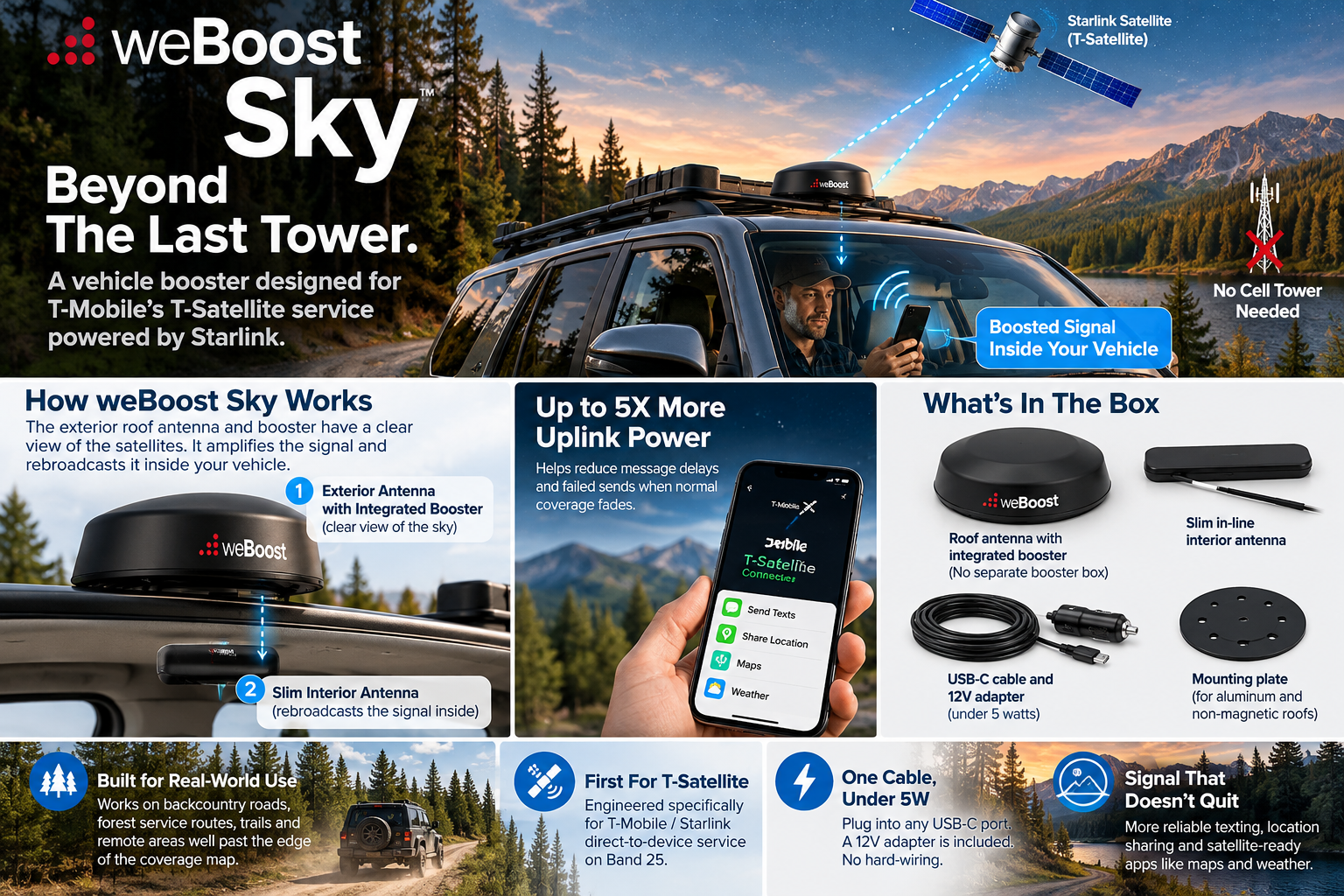
weBoost has introduced a completely different kind of signal booster—one designed specifically for T-Mobile’s T-Satellite direct-to-device service powered by Starlink. John’s Antennas does not have weBoost Sky in stock yet, but we expect to have it available in time for Christmas.
For years, cell phone boosters have worked by taking an existing cellular signal from a traditional cell tower, amplifying it, and bringing that stronger signal inside a vehicle, home, or building.
Now something very different is happening.
T-Mobile’s T-Satellite service uses Starlink satellites to communicate directly with compatible cell phones when conventional cellular towers are no longer available.
And weBoost has just introduced a booster designed specifically for that satellite-to-phone connection.
It is called weBoost Sky.
At $149.99, Sky is designed primarily for vehicles traveling beyond normal cellular coverage—backcountry roads, rural highways, trails, forest-service roads, hunting areas, remote campsites, and other places where the nearest cell tower may be miles away.
At John’s Antennas, we work with both Starlink and cellular signal boosters, so this is one of the more interesting new communications products we have seen in a while.
What Is weBoost Sky?
weBoost Sky is a compact vehicle signal booster designed specifically for T-Mobile T-Satellite service using Starlink’s direct-to-device network.
Unlike a conventional multi-carrier vehicle booster, Sky focuses on Band 25, the cellular spectrum being used for T-Satellite communications.
The system consists of:
- An exterior roof antenna with the booster electronics integrated into it
- A small interior antenna
- A USB-C power cable
- A 12-volt vehicle adapter
- A mounting plate for vehicles with non-magnetic roofs
There is no separate booster box that needs to be mounted somewhere inside the vehicle.
The outside antenna and amplifier sit on the vehicle where they have the clearest possible view of the sky.
The interior antenna then rebroadcasts the strengthened signal inside the vehicle.
Why Would a Satellite Phone Signal Need a Booster?
This is where the product gets interesting.
A Starlink direct-to-device connection is very different from using a conventional Starlink dish.
With T-Satellite, the phone itself communicates with the satellite.
That is remarkable—but a smartphone has limited transmit power and a very small internal antenna.
Put that phone inside a truck, SUV, RV, or other metal vehicle and the connection becomes even more challenging.
The roof and body of the vehicle can reduce an already weak satellite signal.
weBoost Sky moves the receiving and transmitting antenna outside the vehicle, where it has a much clearer view of the satellites overhead.
The system then amplifies the supported signal and brings it inside.
In simple terms:
Your phone no longer has to do all the work from inside a metal box.
Up to 5X More Uplink Power
One of weBoost’s major claims for Sky is up to five times the uplink power of the phone by itself.
Uplink is particularly important with satellite communications because your phone must transmit information back toward the satellite—not merely receive information coming down.
That can affect things such as:
- Sending text messages
- Sharing your location
- Using satellite-enabled mapping applications
- Receiving weather information
- Other applications designed to work with T-Satellite
weBoost reports field-testing improvements of approximately 10 to 20 dB in RSRP, although actual results depend on sky visibility, terrain, vehicle construction, satellite availability, and other conditions.
That is an important qualification.
Like any radio system, there is no guarantee that the same improvement will occur everywhere.
A Real-World Test Under Heavy Tree Cover
One of the more interesting reports from weBoost’s testing came from an overland user in Maine.
According to weBoost, the tester was seeing roughly zero to one bar of T-Mobile satellite reception under heavy tree cover.
At one point, the phone suddenly showed substantially stronger satellite reception. They discovered that the prototype weBoost Sky system had accidentally been switched on.
With the booster operating, they reported successful two-way texting and satellite-enabled mapping.
That does not mean Sky will overcome every forest, mountain, canyon, or obstruction.
But it demonstrates exactly what the product is designed to do:
Improve a marginal T-Satellite connection when the phone alone is struggling.
This Is NOT a Conventional Cell Phone Booster
This distinction is extremely important.
weBoost Sky is not intended to replace a weBoost Drive Reach or other conventional multi-carrier cellular booster.
Sky is designed specifically around T-Mobile/Starlink T-Satellite service on Band 25.
It does not boost the normal range of 4G and 5G cellular frequencies used by Verizon, AT&T, T-Mobile, and other carriers.
So think of the products this way:
weBoost Sky
Designed primarily for situations where conventional cellular coverage has ended and the phone is connecting through T-Satellite and Starlink.
Conventional Vehicle Booster
Designed to improve ordinary cellular service from terrestrial cell towers across supported carrier frequencies.
For many serious travelers, RV owners, contractors, hunters, or overland users, those may eventually become two complementary technologies rather than competing products.
Do You Need a Starlink Dish?
No.
That is one of the most fascinating parts of direct-to-device satellite technology.
T-Satellite communicates directly with compatible smartphones.
There is no Starlink Standard dish or Starlink Mini mounted on the vehicle.
The phone uses cellular-compatible radio technology to communicate with the Starlink constellation.
weBoost Sky simply helps strengthen that supported radio connection.
What Can T-Satellite Do?
T-Satellite is still very different from having a full Starlink internet terminal.
It should not be viewed as a replacement for Starlink Residential, Starlink Roam, or a conventional broadband connection.
Its strength is providing useful communications beyond the last cell tower.
Depending on the compatible phone, service plan, applications, and current T-Satellite capabilities, that can include functions such as:
- Text messaging
- Location sharing
- Mapping
- Weather information
- Selected satellite-compatible applications
The technology will almost certainly continue developing.
But even at its current stage, being able to communicate from a location with no conventional cellular service can be extremely valuable.
Installation Looks Surprisingly Simple
Another interesting feature of weBoost Sky is its simplicity.
The system draws less than 5 watts and can be powered through USB-C.
Installation essentially involves:
- Mounting the exterior antenna/booster on the vehicle roof
- Routing the cable into the vehicle
- Positioning the slim interior antenna
- Connecting power through USB-C or the supplied 12-volt adapter
For aluminum, fiberglass, or other non-magnetic vehicle roofs, weBoost includes a mounting plate.
That makes Sky quite different from larger traditional booster installations involving separate amplifiers, multiple coax connections, and permanently wired power supplies.
Who Is weBoost Sky For?
This product will not be necessary for someone who spends almost all of their time driving around cities and suburbs with strong conventional cellular coverage.
Its real value begins where the towers stop.
Potential users include:
- RV travelers
- Hunters
- Fishermen
- Campers
- Overland travelers
- Ranchers
- Forestry workers
- Contractors working in remote areas
- Emergency-response personnel
- Rural property owners
- People regularly traveling remote highways and back roads
For those customers, reliable communication can be more than a convenience.
What About Heavy Trees?
This is one limitation we want customers to understand.
Starlink satellites are in the sky.
That means sky visibility still matters.
A booster can strengthen a usable signal, but it cannot magically transmit through every mountain, canyon, metal structure, or dense forest canopy.
Tree coverage, terrain, vehicle location, and the satellite geometry at that moment can all influence performance.
The outside roof antenna gives the system an advantage because it is no longer trying to communicate through the vehicle itself.
But a clearer view of the sky is still better.
Will This Replace Cell Towers?
No.
Traditional terrestrial cellular networks remain the best solution in areas where good cellular coverage exists.
Cell towers can provide far greater capacity and performance than current direct-to-device satellite service.
T-Satellite instead fills an important gap:
the places between and beyond those towers.
That is why weBoost’s phrase “Beyond the Last Tower” makes sense.
The satellite network does not need to replace the cellular network to be valuable.
It only needs to provide communication where the cellular network ends.
Will Satellite Service Eventually Replace Traditional Cell Boosters?
We do not think so.
In fact, weBoost Sky demonstrates almost the opposite.
As communications technology changes, there may simply be more types of signals that need to be improved.
A conventional home booster solves the problem of good cellular signal outside a building but weak service inside.
A conventional vehicle booster improves terrestrial cellular reception while traveling.
weBoost Sky addresses a new problem: improving a direct-to-satellite connection when conventional cellular service is no longer available.
Different problem.
Different technology.
Different booster.
John’s Antennas Will Be Carrying weBoost Sky
John’s Antennas does not have weBoost Sky in inventory yet, but we expect to have it available soon—and definitely in time for Christmas.
At $149.99, we think this could be an especially interesting product for RV owners, campers, hunters, rural travelers, and anyone buying a gift for somebody who routinely travels beyond normal cellular coverage.
We have sold and installed cellular boosters for years, and we also work extensively with Starlink and rural connectivity systems.
Seeing those two technologies come together in one small product is particularly interesting to us.
A New Chapter in Rural Communications
A few years ago, the idea that an ordinary smartphone could communicate directly with a satellite constellation without carrying a satellite phone would have sounded remarkable.
Now it is becoming commercially available.
And we already have a signal booster designed to make that connection stronger.
That tells us something important about where rural communications are heading.
The future probably will not be:
cellular OR satellite.
It will increasingly be:
cellular AND satellite, with devices switching between them depending on where the customer happens to be.
For people who live, work, hunt, camp, or travel beyond the traditional coverage map, that is a very significant development.
And now, apparently, even the satellite signal can get a little help from a booster.
Frequently Asked Questions
What is weBoost Sky?
weBoost Sky is a vehicle-mounted signal booster designed specifically to improve T-Mobile T-Satellite direct-to-device service using Starlink satellites on Band 25.
How much does weBoost Sky cost?
weBoost currently lists the system at $149.99.
Does weBoost Sky boost Verizon or AT&T cellular service?
No. Sky is specifically designed for T-Mobile/Starlink T-Satellite service on Band 25. Customers looking for traditional multi-carrier cellular boosting should consider a conventional vehicle booster such as the weBoost Drive Reach family.
Does weBoost Sky require a Starlink dish?
No. T-Satellite communicates directly with compatible smartphones. No traditional Starlink dish is required.
Does it require a subscription?
The booster itself does not require a separate weBoost subscription. However, the user needs a compatible device and an eligible T-Mobile plan or other supported access to T-Satellite service.
How is weBoost Sky powered?
The system uses USB-C power and draws less than 5 watts. A 12-volt vehicle adapter is included.
Will it work under trees?
Performance depends on sky visibility, foliage, terrain, satellite availability, and other conditions. weBoost has reported successful testing under heavy tree cover, but a booster cannot guarantee service when the satellite path is completely obstructed.
Can Sky improve ordinary 4G or 5G service?
It is not designed as an all-band traditional cellular booster. Its primary purpose is improving the Band 25 connection used for T-Satellite service.
When will John’s Antennas have weBoost Sky?
We do not have Sky in stock yet, but we expect to have it available well before Christmas 2026.
Who should consider weBoost Sky?
It may be particularly useful for RV owners, campers, hunters, fishermen, overland travelers, rural workers, and others who regularly travel beyond conventional cellular coverage.
Want to Learn More About weBoost Sky?
John’s Antennas expects to have weBoost Sky available soon, well ahead of the Christmas season. If you spend time beyond normal cellular coverage and want to know whether T-Satellite, Starlink direct-to-device service, or a signal booster makes sense for your vehicle, call John and let’s talk it through. You’re also welcome to stop by our Ocala showroom at 6160 SW Hwy 200, Suite 112, Ocala, Florida, to learn more about weBoost Sky, conventional cell phone boosters, Starlink, and other rural-connectivity solutions