What Is ATSC 3.0? NextGen TV Explained | John’s Antennas
What NextGen TV changes, what it doesn’t, and how to know whether your current antenna, television, tuner, or DVR is ready for ATSC 3.0.
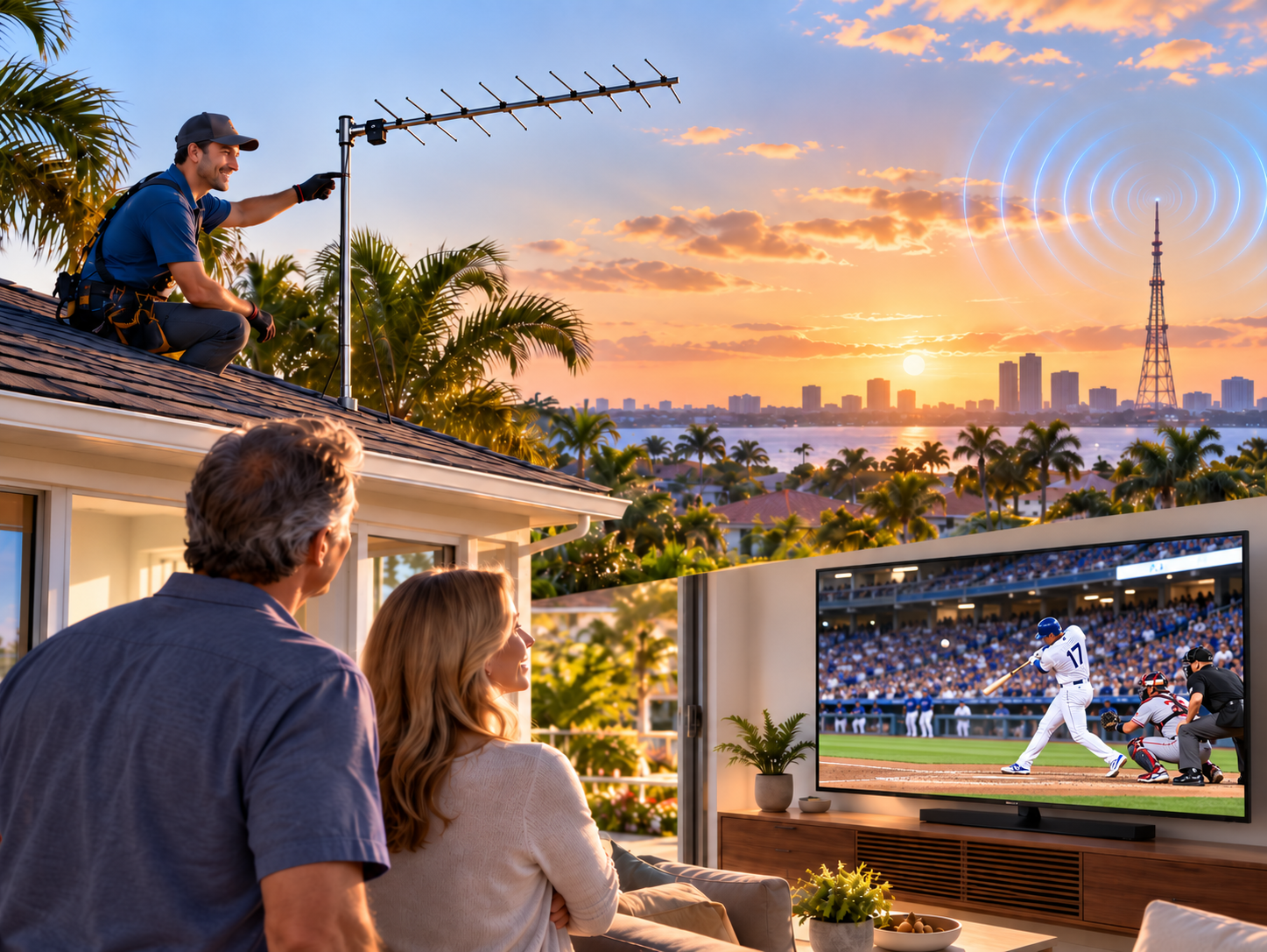
NextGen TV is changing over-the-air television, but most homeowners do not need a new antenna. Here is what ATSC 3.0 actually changes — and what it does not.
If you watch television with an antenna, you may have started seeing terms such as ATSC 3.0, NextGen TV, 4K broadcasting, advanced audio, and even encrypted local channels.
It can make it sound as though the television antenna you already own is suddenly becoming obsolete.
In most cases, it is not.
At John’s Antennas, we have worked with television broadcast systems throughout Central Florida since 1983. We have seen analog television disappear, digital television arrive, stations change frequencies, and new broadcast technologies come and go.
ATSC 3.0 is another major change, but one important fact should come first:
In most cases, you do not need a special ATSC 3.0 antenna. You need an antenna system that delivers a strong, clean signal and a television or tuner capable of decoding ATSC 3.0.
What Is ATSC 3.0?
ATSC 3.0 is the newest generation of the American digital television broadcast standard.
It is commonly marketed to consumers as NextGen TV.
The important distinction is that ATSC 3.0 changes how television programming is transmitted and decoded. It does not create a new type of television antenna.
Your antenna receives radio-frequency energy in the VHF and UHF television bands.
It does not know whether that signal is carrying ATSC 1.0 programming or ATSC 3.0 programming.
The television, tuner, or receiver is what determines whether the digital information inside that signal can be decoded.
Do You Need a Special ATSC 3.0 Antenna?
No.
Be cautious when you see products advertised as:
“ATSC 3.0 antennas,” “NextGen antennas,” or “4K antennas.”
Those terms can be useful marketing descriptions, but they do not represent a fundamentally different antenna technology.
A properly designed antenna that receives the television frequencies used in your area can receive an ATSC 3.0 RF signal just as it can receive an ATSC 1.0 signal.
What matters is whether your antenna system delivers enough clean signal to the tuner.
That still depends on the same things we have dealt with for decades: antenna gain, VHF versus UHF, antenna height, tower direction, terrain, trees, coax loss, splitters, amplifiers, and interference.
ATSC 3.0 does not repeal the laws of radio.
Do You Need a New Television?
Not necessarily.
If your existing television receives your current ATSC 1.0 channels properly, you can continue watching those broadcasts while they remain available.
You only need ATSC 3.0-capable equipment if you want to receive the NextGen TV version of a station.
Some newer televisions include ATSC 3.0 tuners.
Others do not.
Before purchasing a television simply because the box says “4K,” check the specifications specifically for:
ATSC 3.0 or NEXTGEN TV.
A 4K television does not automatically contain an ATSC 3.0 tuner.
If your television does not have one, an external ATSC 3.0 receiver may be an option.
NEXTGEN TV currently recommends looking for certified receiving equipment because protected ATSC 3.0 programming can require compatible security features. Watch NextGenTV
How ATSC 1.0 and ATSC 3.0 Work Together
ATSC 3.0 was not designed as an overnight nationwide switch like the analog-to-digital television conversion.
The transition is happening gradually.
Under current FCC rules, full-power and Class A stations that voluntarily convert to ATSC 3.0 generally must preserve their primary programming in ATSC 1.0 through local simulcasting arrangements. FCC Docs
This often means several stations in a television market cooperate.
One station may transmit the ATSC 3.0 signals for several broadcasters while other stations host their ATSC 1.0 signals.
The actual RF frequency carrying your station can therefore change even though the virtual channel number displayed on your television may remain familiar.
That is one reason antenna reception can occasionally change when a market reorganizes its broadcasts.
Does ATSC 3.0 Mean Everything Will Be in 4K?
No.
ATSC 3.0 has the technical capability to support higher-resolution video and other advanced picture formats.
That does not mean every station using ATSC 3.0 is broadcasting 4K programming.
A station can transmit ATSC 3.0 while providing programming in resolutions such as 1080p or 720p.
Think of ATSC 3.0 as giving broadcasters a larger toolbox.
Whether they use every tool in that box is another matter.
What Are the Benefits of NextGen TV?
ATSC 3.0 can support better video compression, advanced audio, improved emergency-information capabilities, more flexible reception options, mobile applications, and interactive features.
Because ATSC 3.0 was designed as an IP-based broadcast system, broadcasters can also combine over-the-air television with broadband-delivered features when compatible equipment is connected to the internet.
Some features depend on the broadcaster, some depend on the television or receiver, and some require internet connectivity.
So when you hear that ATSC 3.0 “does” something, the better question is often:
Does my local station provide that feature, and does my equipment support it?
NEXTGEN TV itself notes that available features vary by broadcaster and receiving device. Watch NextGenTV
Will ATSC 3.0 Improve Weak TV Reception?
Possibly in some circumstances — but do not buy equipment expecting a miracle.
ATSC 3.0 uses a different transmission system from ATSC 1.0 and gives broadcasters more flexibility in balancing coverage, capacity, and robustness.
That may produce reception advantages in some installations.
But ATSC 3.0 cannot fix every antenna problem.
If your antenna is pointed in the wrong direction, hidden behind heavy trees, receiving the wrong frequency band, connected through damaged coax, or feeding an overloaded distribution system, changing the tuner will not correct those problems.
A good signal remains a good signal.
A bad antenna installation remains a bad antenna installation.
What Is the ATSC 3.0 DRM Issue?
Consumers should pay attention to this before buying an external tuner or DVR.
ATSC 3.0 allows broadcasters to use Digital Rights Management, or DRM, to protect programming.
Not every ATSC 3.0 broadcast is necessarily encrypted, but protected programming requires compatible receiving equipment.
ATSC continues to maintain DRM and security standards, including updated documents released during 2026. ATSC : NextGen TV
The practical lesson for the homeowner is simple:
Do not purchase an ATSC 3.0 tuner solely because it says “ATSC 3.0.”
Check that it supports the protected broadcasts used by the stations you want to receive.
This is particularly important with external tuners, network tuners, and DVRs.
What About Tablo?
As of October 2026, 4th-generation Tablo DVRs support ATSC 1.0, not ATSC 3.0.
When I contacted Tablo on October 1, 2026, its automated support representative said there had been no formal announcement of ATSC 3.0 support in a future fifth-generation Tablo.
That does not make a current Tablo useless.
ATSC 1.0 remains widely used, and Tablo remains an excellent way for many antenna customers to watch and record their existing over-the-air channels throughout the home.
But if your specific goal is recording ATSC 3.0 programming, do not assume a current Tablo will do it.
ATSC 3.0 support varies considerably among OTA DVRs, so it is important to check the exact model before purchasing.
Will You Need to Rescan Your Channels?
Sometimes.
A rescan is appropriate when a television station has changed frequencies, reorganized its broadcast service, or when a known ATSC 3.0 launch has changed what your receiver needs to find.
But we do not recommend rescanning simply because a channel suddenly becomes weak or disappears during poor reception conditions.
A rescan does not improve signal strength.
In fact, if the television cannot detect a marginal station during the scan, it may remove that channel from the stored lineup.
Fix reception problems first. Rescan when there has been a genuine broadcast change or after the reception problem has been corrected.
Is NextGen TV Available in Central Florida?
Yes.
As of October 2026, NEXTGEN TV lists several Florida markets with ATSC 3.0 service, including Orlando, Tampa, Jacksonville, Miami, Tallahassee, and West Palm Beach. Availability of individual stations and features varies by market and broadcaster. Watch NextGenTV
For Central Florida viewers, that does not mean every home will receive every NextGen TV signal.
Your actual reception still depends on your location, antenna system, tower direction, terrain, and distance from the transmitters.
Before You Spend Money on ATSC 3.0 Equipment
Do not replace a perfectly good antenna because someone tells you that you now need a “NextGen antenna.”
And do not automatically replace a television because ATSC 3.0 exists.
Start by determining what you already have.
Check whether your television includes an ATSC 3.0 tuner.
Find out whether the stations you actually watch are broadcasting NextGen TV in your reception area.
Determine whether your current antenna receives those frequencies properly.
And if you are considering an external tuner or DVR, check ATSC 3.0 and DRM compatibility before you purchase it.
That approach can save a lot of unnecessary expense.
John’s Antennas and NextGen TV
John’s Antennas has served Central Florida since 1983.
We have watched broadcast television evolve from analog reception through digital TV and now into ATSC 3.0.
The equipment changes.
The basic antenna principles do not.
If your existing antenna delivers a strong, clean signal, there is a very good chance the antenna itself can continue serving you as television broadcasting evolves.
If you are unsure whether your television, tuner, DVR, or antenna system is ready for NextGen TV, call John and let’s look at what you already have before you start replacing equipment.
Sometimes you need something new.
Sometimes you already own everything you need.
Frequently Asked Questions
Do I need a special antenna for ATSC 3.0?
No. ATSC 3.0 uses the same television broadcast frequency bands received by conventional VHF/UHF TV antennas.
What you need is an antenna appropriate for the frequencies and reception conditions at your property.
Will my old antenna work with NextGen TV?
In many cases, yes. If the antenna provides a strong signal on the RF channel carrying the ATSC 3.0 broadcast, the antenna itself generally does not need to be replaced.
Will my old television receive ATSC 3.0?
Only if it contains an ATSC 3.0 tuner. Older televisions generally contain ATSC 1.0 tuners. You may be able to add an external ATSC 3.0 receiver rather than replacing the television.
Does a 4K television automatically receive ATSC 3.0?
No. Screen resolution and tuner capability are different specifications. Check the television specifications for ATSC 3.0 or NEXTGEN TV.
Does ATSC 3.0 guarantee 4K television?
No. The standard can support advanced video formats, but broadcasters decide what they transmit. An ATSC 3.0 station is not necessarily broadcasting 4K programming.
What is DRM on ATSC 3.0?
DRM stands for Digital Rights Management. Some broadcasters use content protection on ATSC 3.0 programming. A compatible and properly authorized receiver may be required to view protected broadcasts.
Does the current Tablo receive ATSC 3.0?
The current 4th-generation Tablo supports ATSC 1.0, not ATSC 3.0. Tablo says an ATSC 3.0-compatible product is under development, but no release date has been announced. Tablo Support
Should I rescan my channels for ATSC 3.0?
A rescan may be useful after a known station launch or frequency change. Do not use a rescan as the first solution for weak reception because a temporarily weak channel can disappear from the stored lineup.
Will ATSC 3.0 make my antenna reception better?
It may provide advantages in some situations, but it does not eliminate problems caused by poor antenna selection, obstructions, damaged coax, incorrect aiming, or inadequate signal strength.
Should I buy new equipment now?
Not necessarily. If your existing system is working properly, first determine whether the NextGen TV features available in your area provide something you actually want. Then purchase new equipment only when there is a clear reason to do so.