TV Antenna Rotators Are Hard to Find—But John’s Antennas Still Has Them
TV Antenna Rotators Are Hard to Find—But John’s Antennas Still Has Them
After major manufacturers left the antenna-rotator business, John’s Antennas built and maintained an inventory of hard-to-find rotators
TV antenna rotators—also commonly called antenna rotors—were once readily available from RadioShack, Channel Master, RCA, Antennacraft, and other well-known suppliers.
Many familiar models have been discontinued, replacement parts for older systems can be scarce, and the selection of currently manufactured consumer rotators remains limited.
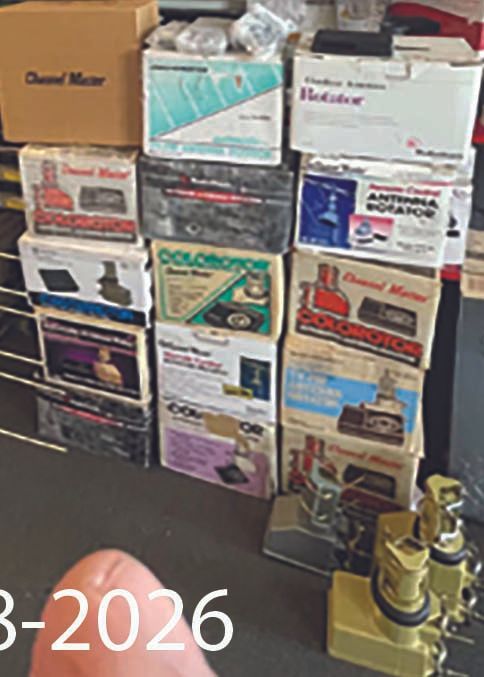
John’s Antennas recognized this developing shortage years ago. By purchasing inventory before production ended and continuing to search nationwide for new old stock, we have maintained a selection of antenna rotators for customers who still need them.
What Does a TV Antenna Rotator Do?
An antenna rotator is an electrically operated motor installed on an antenna mast. It allows the homeowner to turn a directional outdoor antenna toward broadcast towers located in different directions.
For example, a Central Florida home may receive its strongest Orlando stations from one direction but need to turn the antenna toward Gainesville, Tampa, or another market to receive additional channels.
The indoor control box operates the outdoor motor, allowing the customer to change the antenna’s direction without physically climbing to the antenna.
A rotator can be especially useful when:
- The desired broadcast towers are located in substantially different directions.
- A highly directional antenna is required for distant stations.
- One fixed antenna position cannot reliably receive all desired channels.
- Installing multiple antennas is impractical.
- The customer wants to receive stations from more than one television market.
What Happened to the Antenna-Rotator Industry?
The shortage developed gradually as several familiar manufacturers and suppliers reduced or discontinued their consumer antenna-rotator offerings.
RadioShack filed for Chapter 11 bankruptcy in February 2015. Around that period, its Archer-branded equipment and Antennacraft rotators gradually disappeared from normal distribution. RCA- and Magnavox-branded rotators also became increasingly difficult to obtain through regular suppliers.
Channel Master’s CM-9521A had long been one of the better-known consumer TV antenna rotators. Based on our purchasing history, it became increasingly difficult to obtain through regular distributors around 2019. Channel Master subsequently offered the CM-9521HD, which is currently available again.
Although availability has improved, the consumer rotator market still offers far fewer choices than it once did—particularly for customers who need to replace or match older equipment.
John Saw the Shortage Coming
John Pearce has worked in the television antenna and satellite industry since 1983. As familiar rotator models began disappearing from regular distribution, he recognized that customers would continue needing replacement systems, control boxes and compatible components.
In 2015, John’s Antennas made a substantial purchase of Antennacraft rotators as inventory became available following the RadioShack bankruptcy and Antennacraft shutdown. That supply served our customers until the final units were sold in 2025. We also purchased multiple cases of RCA-brand rotators.
When the Channel Master CM-9521A became increasingly difficult to obtain around 2021, John used the company’s available purchasing credit to acquire as many units as possible. That investment allowed John’s Antennas to continue supplying rotators after many established models had disappeared from most distributors and retail stores.
John’s Antennas Still Has Rotators in Stock
As of September 2026, John’s Antennas has had antenna rotators available continuously.
Our inventory has included:
- Channel Master CM-9521A rotators
- Channel Master CM-9521HD rotators
- Older Channel Master CM-9510 and CM-9510A rotators, including U.S.-made units
- RadioShack and Archer TDP-2 rotators
- RCA rotators
- Mastercraft rotators
- DelMar rotators
- Other compatible equipment and components
Inventory changes as units sell or as we find additional equipment.
John continues to scour the country for new old stock rotators. This may include equipment found in closed dealerships, distributor warehouses, former antenna shops, and private inventories.
What Is a New Old Stock Rotator?
“New old stock,” commonly abbreviated as NOS, describes equipment manufactured years ago but never placed into regular service.
The rotator may be an older discontinued model even though the unit itself was never installed. Packaging condition can vary because of the product’s age and how it was stored.
New old stock is increasingly important in the antenna business because many respected rotators are no longer manufactured. In some cases, locating an unused older model is the best way to replace an existing rotator or preserve compatibility with an established antenna system.
Because these products are scarce, always confirm the model and condition before purchase or installation.
Every Rotator Is Tested Before Shipment
Because many discontinued rotators are acquired as new old stock or open-box equipment, John personally tests each rotator before shipping. The motor, control unit, and operating functions are checked to confirm that the system performs as designed. This extra step helps ensure customers receive a functioning rotator—not simply an older product that has sat unopened for years.
Why Do Some Older Antenna Rotators Cost More Today?
Customers sometimes find an old manufacturer’s suggested retail price online and wonder why an available rotator costs considerably more today.
The important distinction is that many of the older models we carry are no longer available through normal wholesale distribution. Their present value cannot always be compared with an original catalog price or with the price of a currently manufactured model.
John’s Antennas must locate scarce new old stock from dealers, closed businesses, private inventories, and other sources nationwide. We frequently pay substantially more than the original wholesale or retail price to acquire these rotators. Additional expenses may include shipping, missing components, storage, and the time required to locate complete systems.
Pricing on older or discontinued equipment reflects its condition, scarcity, acquisition cost, testing, completeness and replacement cost—not simply the price printed in a catalog years ago.
We understand that a scarce rotator may not fit every customer’s budget. Before recommending one, we can evaluate whether a fixed antenna, broader-pattern antenna, combined antenna system, or another solution would provide the desired channels at a lower overall cost.
Is a Rotator Right for Every Antenna System?
No. A rotator is valuable in the right situation, but it is not automatically the best solution for every home.
Before recommending one, we evaluate:
- The direction of the desired broadcast towers
- Signal strength from each television market
- Antenna size and wind load
- Mast diameter and mounting arrangement
- Tree cover, terrain and nearby obstructions
- The number of televisions in the home
- Whether the customer uses a Tablo or another whole-home DVR
- Whether a fixed or broader-pattern antenna can receive the desired stations
If most broadcast towers are located within the useful reception pattern of one properly selected antenna, a rotator may not be necessary.
In other situations, two antennas, a broader-pattern design, or a different mounting location may provide more convenient reception.
Rotators, Multiple TVs and Tablo DVRs
Customers should understand that everyone connected to a rotating antenna shares its current direction.
If one person turns the antenna toward Gainesville, another television may temporarily lose weaker Orlando stations. The same issue can affect a Tablo DVR. A scheduled recording may fail if the antenna is pointed away from the station when the program begins.
That does not mean a rotator cannot be used with multiple televisions or a Tablo. It simply means the system must be designed around the household’s viewing and recording habits.
For a single television, a hobbyist or customer searching for stations from multiple markets, a rotator may be an excellent solution. For a whole-home system with several viewers and automatic DVR recordings, another antenna arrangement may be more convenient.
Replacing an Existing Antenna Rotator
A failed rotator doesn't necessarily mean you need to replace the entire antenna system.
Depending on the existing installation, we may be able to:
- Replace the outdoor rotator motor
- Replace or match the indoor control box
- Install a compatible new old stock system
- Reuse suitable existing rotator wire
- Replace damaged wiring or connections
- Realign and recalibrate the antenna
- Recommend a fixed-antenna alternative
Compatibility must be checked carefully. Older systems may use different wiring, control methods, mast sizes and mounting arrangements.
Contact Us About Rotator Availability
Availability has improved for at least one current rotator model, but many older rotators, matching control boxes and replacement components remain difficult to find.
John’s Antennas currently has several hard-to-find rotator models and continues searching across the country for additional new-old-stock equipment. However, we cannot guarantee that every model will remain available.
If you need a replacement antenna rotator, control box, complete system, or professional installation, contact us with the manufacturer and model number of your existing equipment whenever possible.
John’s Antennas has served Central Florida since 1983.
Call us to discuss rotator availability, compatibility, or professional installation.