Why Your TV Signal Breaks Up During Storms | John’s Antennas
Learn why storms can cause TV pixelation, picture freezes, and missing channels—and what to check before replacing your antenna.
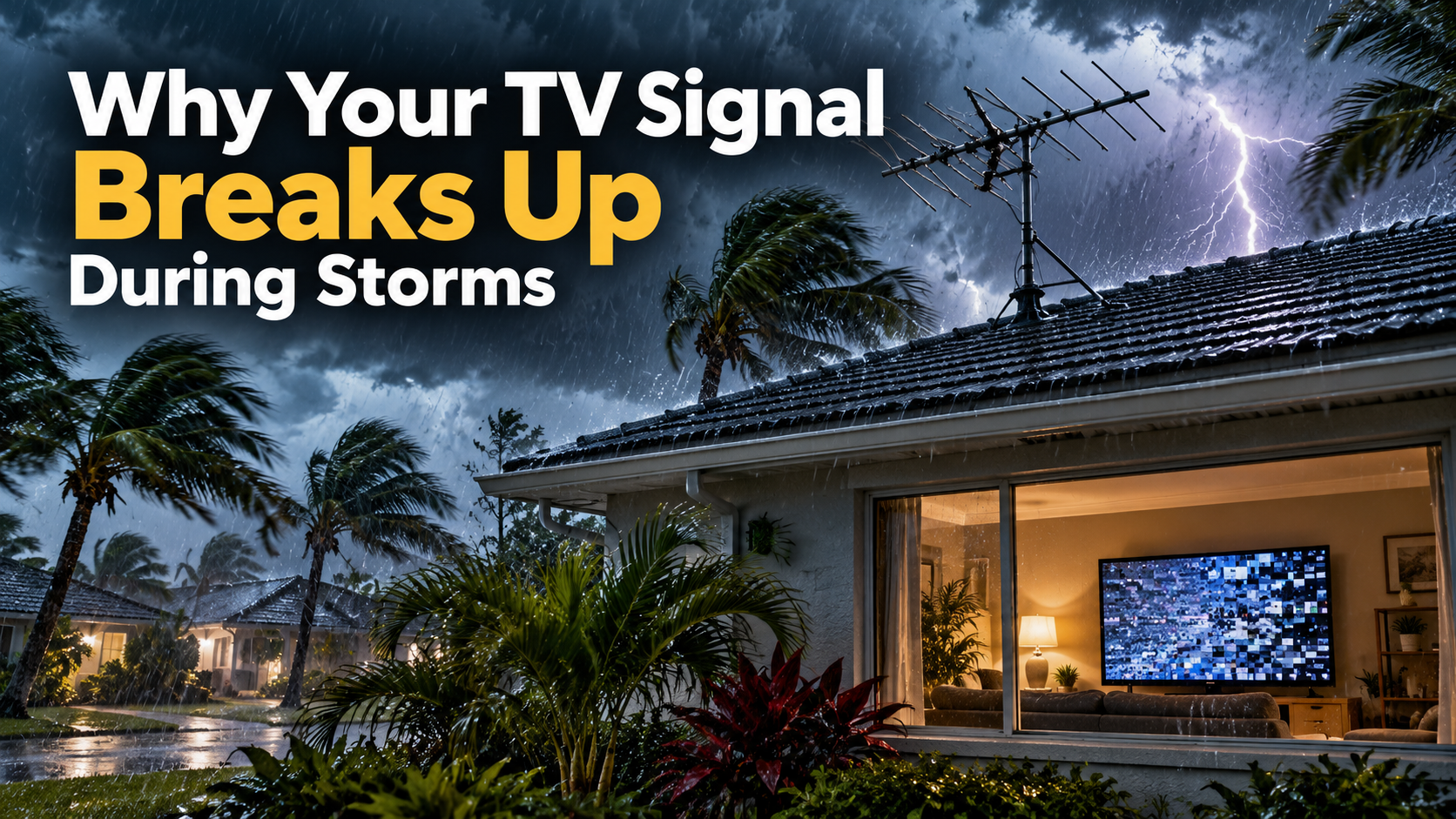
Why Your TV Signal Breaks Up During Storms
Why rain, wind, wet foliage, and marginal signal levels can cause pixelation — and what to check after the storm passes.
Florida thunderstorms can turn a perfectly watchable television picture into a screen full of blocks, freezes, and missing channels.
When that happens, many homeowners assume the rain itself is simply blocking the TV signal.
With over-the-air television, the real answer is usually more complicated.
At John’s Antennas, we have installed and repaired television antenna systems throughout Central Florida since 1983. In our experience, storm-related reception problems usually expose a weakness that was already present in the antenna system.
A strong, properly installed system often rides through normal weather changes with little trouble.
A marginal system may not.
Why Storms Can Cause TV Pixelation
Digital television has what is sometimes called a digital cliff.
When the signal reaching the television is strong enough, the picture can look perfect.
But once the signal falls below the level the tuner needs, the picture may suddenly:
- Pixelate
- Freeze
- Lose sound
- Break into blocks
- Disappear completely
That is why digital TV can seem perfect one minute and nearly unwatchable the next.
The storm may only need to change the signal by a small amount to push an already-marginal channel over that edge.
Rain Is Usually Not the Whole Story
Heavy rain gets blamed for many television reception problems, but VHF and UHF broadcast television signals are not affected by rain in the same way that higher-frequency satellite signals can be.
Instead, several things may be happening at the same time.
Wet Trees and Foliage
Trees are one of the biggest reception challenges we encounter in Central Florida.
When leaves and branches become wet, they can alter, scatter, or weaken the signal reaching the antenna.
If the antenna is already receiving a marginal signal through heavy tree cover, a storm can be enough to cause the picture to start breaking up.
Wind
Wind can move tree limbs through the signal path.
It can also cause an antenna, mast, or tower-mounted system to move slightly.
That does not necessarily mean the antenna has been permanently knocked out of alignment. Even temporary movement can change the signal enough to affect a marginal channel.
Multipath
Television signals do not always travel directly from the transmitter to your antenna.
They can reflect from buildings, terrain, trees, and other objects and reach the antenna from several directions.
This is called multipath.
Changing weather conditions, moving foliage, and wind can change those reflected paths.
A digital television tuner can compensate for a certain amount of multipath, but difficult conditions can still cause pixelation and dropouts.
Electrical Interference
Thunderstorms also produce electrical activity.
Lightning, power-line disturbances, and other electrical noise can create short bursts of interference that affect television reception.
If the interference occurs at the same time a channel is already close to the tuner’s minimum usable signal level, the effect can be very noticeable.
Water in Coax and Connections Can Cause Lasting Problems
One of the biggest differences between a temporary storm problem and an actual antenna repair problem is what happens after the storm ends.
If reception returns to normal once the weather clears, you may simply have a marginal signal problem.
If channels remain weak or missing afterward, something may have changed physically.
Water can enter:
- Outdoor coax connectors
- Splitters
- Preamplifiers
- Matching transformers
- Antenna connection points
- Damaged coaxial cable
Moisture inside coax or connectors can increase signal loss and eventually cause corrosion.
Florida’s combination of rain, heat, humidity, and sun makes weatherproof outdoor connections especially important.
Do Not Rescan Your TV First
This is an important one.
When channels disappear during or immediately after a storm, do not automatically perform a channel rescan.
A rescan does not make a weak signal stronger.
If a channel is temporarily too weak for the television to detect during the scan, the TV may remove that channel from its stored lineup.
Instead, first determine whether the reception problem is temporary or whether something has changed in the antenna system.
A rescan is more appropriate when a television station has changed its broadcast frequency or when the reception problem has already been corrected and you need to rebuild the channel list.
What to Check After a Storm
You can make several useful checks without climbing onto a roof or tower.
Check More Than One Television
If several televisions use the same antenna system, see whether all of them lost the same channels.
If only one television has a problem, the issue may be in that room’s coax, splitter, wall plate, or television.
If every television has the same problem, start looking farther upstream in the antenna system.
Check Indoor Connections
Look for loose coax connections behind the television and at accessible splitters.
A connection that was already marginal may become more noticeable when signal conditions worsen.
Look at the Antenna From the Ground
If you can see the antenna safely from the ground, check whether anything looks obviously different.
Look for:
- A bent mast
- Missing antenna elements
- A rotated antenna
- Loose hardware
- Tree limbs resting against the antenna
- Storm damage near the installation
Do not climb onto a wet roof or tower to investigate.
Give the Weather Time to Clear
If reception returns once the storm passes, make a note of which channels were affected.
Repeated storm-related pixelation on the same channels may indicate those channels have very little signal margin at your home.
That does not automatically mean you need a new antenna.
Sometimes the solution is antenna aiming, additional height, tree clearance, a different antenna, correcting coax losses, or selecting the proper preamplifier.
When a Storm Reveals a Marginal Antenna System
One of the best ways to think about storm-related reception problems is signal margin.
Suppose your television needs a certain minimum signal level to decode a channel reliably.
If your antenna delivers considerably more than that minimum, small changes in weather may not matter.
But if you are operating just above the minimum, a relatively small change in the signal path can push the channel below the tuner’s threshold.
That is why one neighbor may watch the same station throughout a storm while the house next door loses it.
The two systems may have different:
- Antenna types
- Antenna heights
- Aiming
- Tree obstructions
- Coax lengths
- Splitter losses
- Amplifiers
- Terrain
- Signal paths
The storm may be exposing the weakness rather than causing it.
What If Reception Does Not Return After the Storm?
If channels remain missing after the weather clears, we start looking for physical changes in the system.
Possible causes include:
- Antenna movement
- Damaged antenna elements
- Loose mounting hardware
- Water-damaged coax
- Corroded connectors
- Failed preamplifiers
- Damaged power supplies
- Failed splitters
- Lightning or surge damage
A professional signal test can help determine where the loss is occurring.
Instead of replacing parts at random, we can compare signal levels at different points in the system and isolate where the problem begins.
What About Antenna Grounding?
Outdoor antenna systems should be installed in accordance with applicable electrical and building requirements.
The National Electrical Code includes requirements addressing grounding and bonding of outdoor antenna systems, supporting masts, and lead-in conductors.
Proper grounding and bonding can help manage static charges and electrical surges and are an important part of a code-compliant installation.
However, grounding should not be described as making an antenna immune to lightning.
A direct or nearby lightning event can damage antennas, televisions, amplifiers, network equipment, and other electronics even when an installation is properly grounded.
Because grounding and bonding requirements depend on the installation and the electrical grounding system at the property, this is an area where proper installation matters.
Florida Weather Is Hard on Outdoor Antenna Systems
Central Florida gives outdoor antennas a workout.
We deal with:
- Heavy thunderstorms
- High winds
- Extreme heat
- UV exposure
- Humidity
- Rapid tree growth
- Lightning
- Hurricanes and tropical weather
An antenna system that has been outdoors for many years may gradually develop problems that become obvious during severe weather.
Sometimes a storm causes the damage.
Other times the storm simply reveals a connector, cable, amplifier, or mounting problem that was already developing.
Already Have an Antenna? It May Be Repairable
A storm-related reception problem does not necessarily mean you need an entirely new antenna system.
John’s Antennas repairs and upgrades existing antenna systems, including installations originally performed by other companies or by homeowners.
Depending on what we find, the solution may involve:
- Re-aiming the antenna
- Repairing or replacing coax
- Replacing damaged connectors
- Correcting splitter losses
- Replacing a failed preamplifier
- Repairing mounting hardware
- Raising or relocating the antenna
- Replacing damaged antenna components
Sometimes a relatively small repair can restore a system that otherwise performs very well.
When to Call John’s Antennas
If your picture occasionally breaks up during a severe thunderstorm but returns to normal afterward, you may simply be seeing the effects of a marginal channel during difficult reception conditions.
But if the problem happens every time it rains, becomes progressively worse, or continues after the storm passes, it is worth investigating.
John’s Antennas has served Central Florida since 1983.
We install, repair, and upgrade television antenna systems ranging from straightforward residential antennas to high-gain rural and tower-mounted systems.
If storms are causing missing channels, pixelation, or picture freezes, call John and let’s discuss what your antenna is doing before replacing equipment that may still be perfectly good.
The goal is not simply to get the picture back after the storm.
The goal is to give the system enough dependable signal margin that ordinary Florida weather does not knock it over the digital cliff.
Frequently Asked Questions
Why does my TV pixelate during thunderstorms?
Storms can change the reception environment around an antenna. Wet foliage, moving trees, multipath, wind, electrical interference, or an already-marginal signal can push a digital channel below the level your television needs to decode it reliably.
Does rain block an over-the-air TV signal?
Normal rain does not usually attenuate VHF and UHF television signals the way it can affect higher-frequency satellite signals. However, wet foliage, changing propagation conditions, electrical interference, and other storm-related factors can affect reception.
Should I rescan my television after a storm?
Usually not as your first troubleshooting step. If a channel is temporarily weak when you rescan, the television may remove it from the stored channel list. Correct the reception problem first. Rescanning is more appropriate after a station changes frequency or when you need to rebuild the channel lineup after reception has been restored.
Why did my channels not come back after the storm?
If reception remains poor after the weather clears, the system may have suffered physical damage or water intrusion. Common problems include shifted antennas, loose connections, damaged coax, failed preamplifiers, corroded fittings, or surge damage.
Can wet trees affect TV antenna reception?
Yes. Wet foliage can change or weaken the radio-frequency path between a television transmitter and your antenna. This is particularly noticeable when the antenna is already receiving a marginal signal through heavy tree cover.
Should an outdoor TV antenna be grounded?
Outdoor antenna systems are subject to electrical-code requirements for grounding and bonding. Proper grounding and bonding are important for electrical safety and surge management, but they do not guarantee protection from a direct or nearby lightning strike.
Can John’s Antennas repair an antenna after storm damage?
Yes. We troubleshoot, repair, and upgrade existing television antenna systems. Depending on the problem, we may be able to repair the existing installation rather than replace the entire antenna system.