How to Test Cell Signal Strength at Home | John’s Antennas
Learn how to check your real cell signal strength in dBm, compare indoor and outdoor readings, and determine whether a cellular booster may help your home.
How to Test Cell Signal Strength at Home
Before buying a cell phone signal booster, learn how to check your real signal strength, compare indoor and outdoor readings, and determine whether your home may be a good candidate for amplification.
Weak cellular service can be frustrating. Calls drop, text messages take too long to send, web pages stall, and sometimes your phone works perfectly outside but barely works inside the house.
Before buying a cell phone signal booster, it helps to know what signal you actually have.
At John’s Antennas, we have worked with radio-frequency systems throughout Central Florida since 1983. When evaluating a cell phone signal problem, we do not rely only on the little bars at the top of the phone.
We want to know what the signal is doing outside the home, inside the home, and in the areas where you actually need reliable service.
Why Cell Phone Bars Can Be Misleading
The bars displayed on a cell phone are convenient, but they are not a precise measurement.
Different phones and carriers may display the same cellular signal differently. One phone might show two bars while another phone at the same location shows three.
For a better measurement, we look at cellular signal strength in dBm, or decibel-milliwatts.
The important thing to remember is:
The closer the number is to zero, the stronger the signal.
For example:
-75 dBm is considerably stronger than -105 dBm.
Because the numbers are negative, the larger-looking negative number actually represents the weaker signal.
What Is a Good Cell Signal Strength?
There is no single dBm number that guarantees perfect cellular service because modern LTE and 5G performance also depends on signal quality, interference, network congestion, frequency band, and other factors.
However, this is a useful general guide:
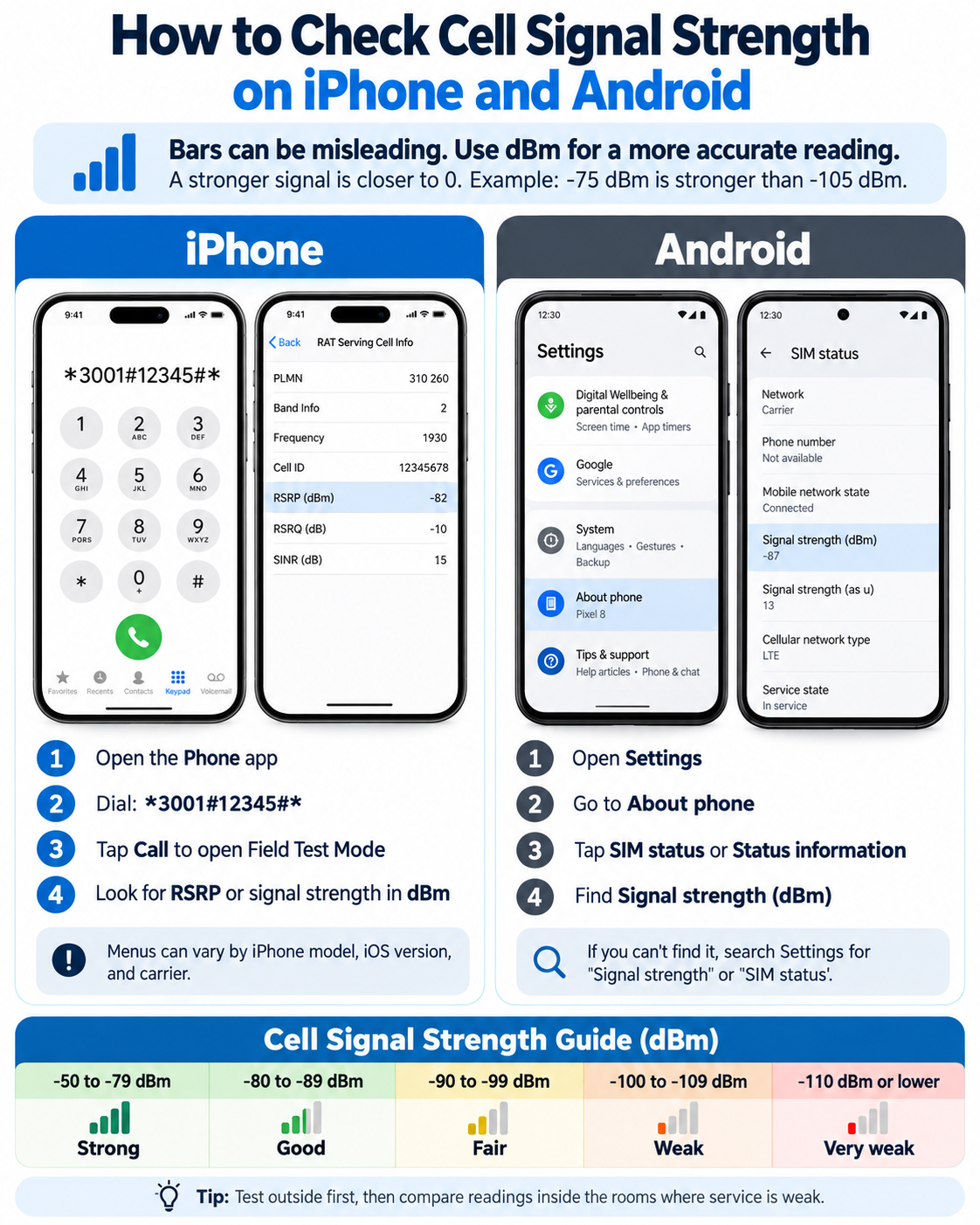
- -50 to -79 dBm: Strong signal
- -80 to -89 dBm: Good signal
- -90 to -99 dBm: Fair signal
- -100 to -109 dBm: Weak signal
- -110 dBm or lower: Very weak signal
Do not treat these numbers as pass-or-fail limits.
A phone may still place calls at -105 dBm, while another location with what appears to be a stronger signal may perform poorly because of interference or network congestion.
That is why we look at both the number and how the phone actually performs.
Signal Strength and Signal Quality Are Not the Same Thing
This is an important distinction.
Signal strength tells us how much cellular radio energy the phone is receiving.
Signal quality tells us how clean and usable that signal is.
You can occasionally have a reasonably strong signal but still experience slow data or poor calls because of interference, congestion, or poor signal quality.
On LTE and 5G phones, you may see measurements such as:
- RSRP
- RSRQ
- SINR
- RSSI
For the average homeowner, you do not need to become a cellular engineer.
The main number we want you to start with is the signal strength in dBm, particularly the RSRP reading when your phone displays it.
How to Test Cell Signal Strength on an iPhone
On many iPhones, you can open Apple’s Field Test Mode by dialing:
*3001#12345#* and pressing the call button.
The exact screens and menu names can vary depending on the iPhone, iOS version, carrier, and whether the phone is connected to LTE or 5G.
Look for a cellular measurement such as RSRP or a signal reading displayed in dBm.
Remember:-80 dBm is stronger than -100 dBm.
Do not be surprised if the menu on your phone looks different from screenshots you find online. Apple has changed
Field Test Mode several times over the years.
How to Test Cell Signal Strength on an Android Phone
Android phones vary considerably by manufacturer.
On many Android devices, signal information can be found under something similar to:
Settings → About Phone → SIM Status → Signal Strength
or:
Settings → About Phone → Status Information
If you cannot find it, use the search function in Settings and search for:
Signal strength
or:
SIM status
The phone may display the reading directly in dBm.
Test Outside Before You Test Inside
This is one of the most important parts of determining whether a cell phone booster may help.
Start outside the house.
Walk around the property and take signal readings on several sides of the home.
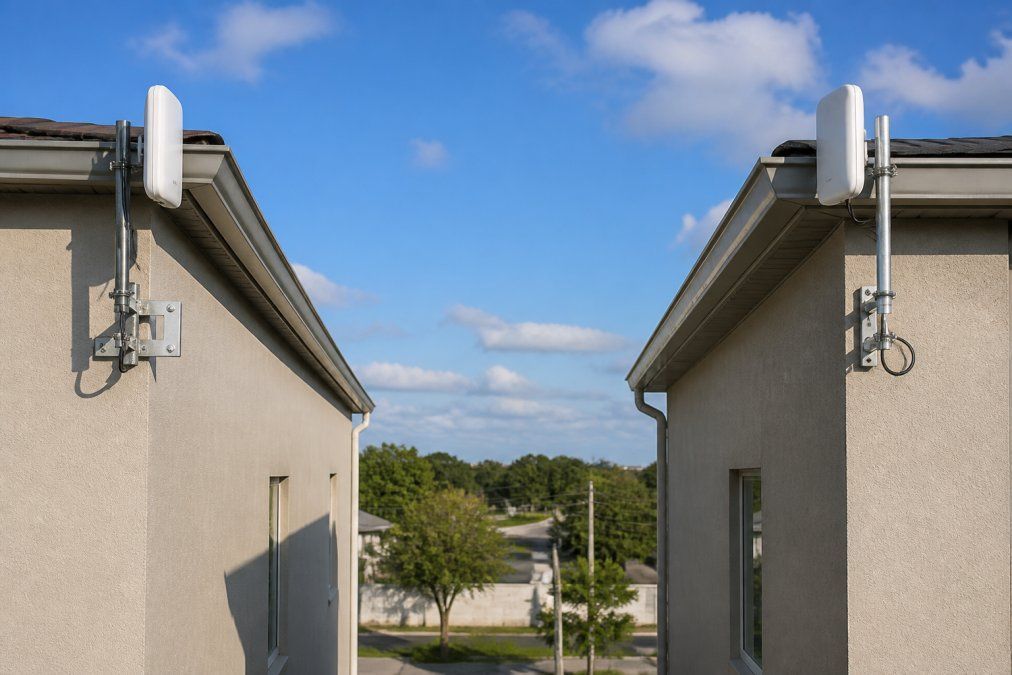
Pay particular attention to areas where an outside donor antenna could realistically be mounted, such as:
- An exterior wall
- Roof edge
- Eave
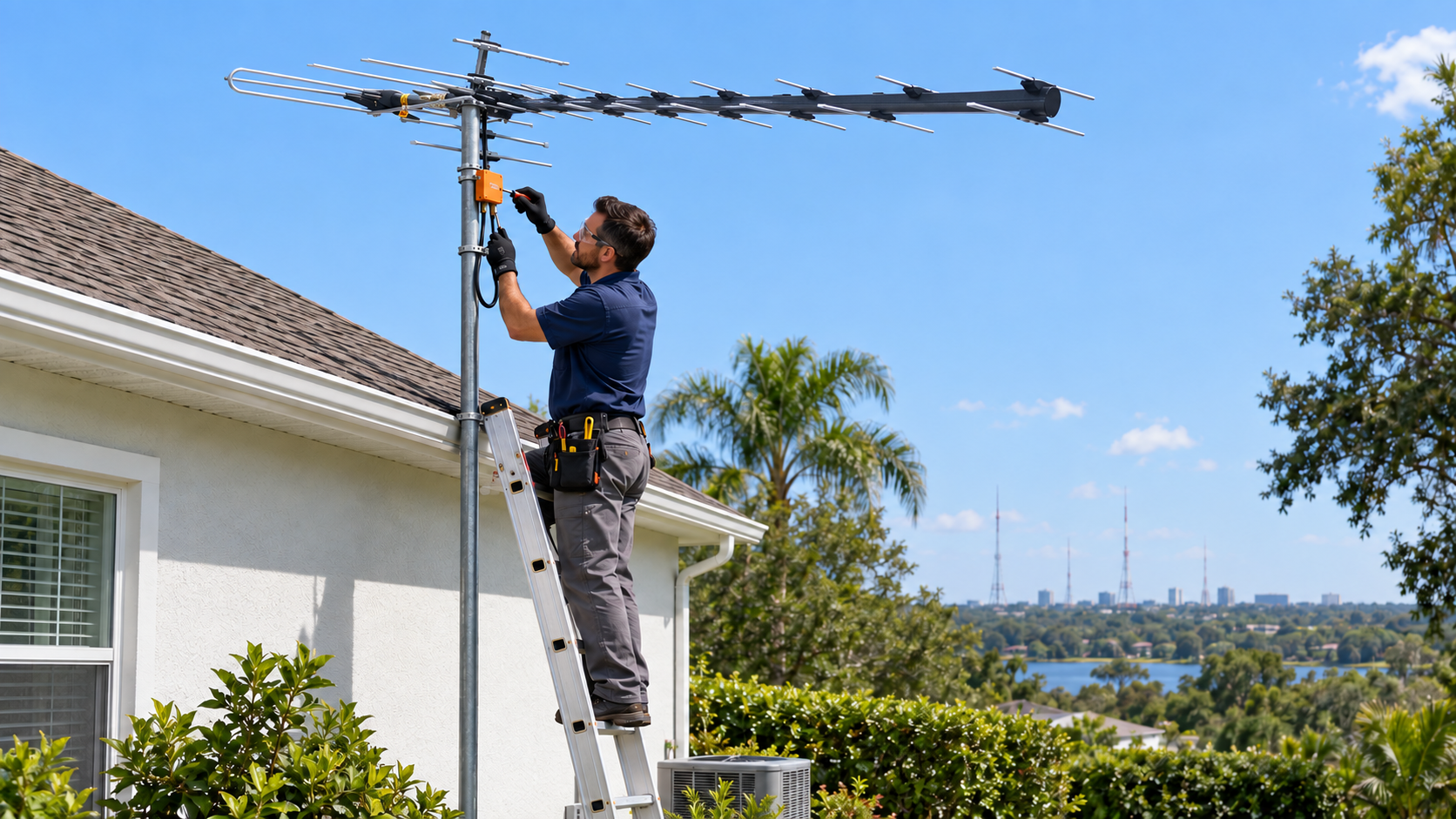
- Existing mast
- Tower
- Other elevated mounting location
Allow the phone a little time to update after you move to a new location.
Write down your readings.
Then go inside and check the rooms where cellular service gives you the most trouble.
Compare Your Outside Signal With Your Inside Signal
Suppose you find:
Outside: -85 dBm
but:
Inside bedroom: -108 dBm
That tells us something important.
There is usable cellular signal outside the building, but the structure is substantially reducing it before it reaches the phone indoors.
That is exactly the type of situation where a properly designed cellular booster system may be very helpful.
Building materials that can reduce cellular signals include:
- Metal roofing
- Concrete and masonry
- Stucco with metal mesh
- Low-E windows
- Metal siding
- Radiant-barrier materials
- Foil-backed insulation
- Energy-efficient building materials
Florida homes can present some interesting cellular challenges because construction methods designed for hurricanes and energy efficiency are not always friendly to radio signals.
What If the Signal Is Poor Outside Too?
This is where booster selection becomes more important.
A cell phone signal booster cannot manufacture a cellular signal that does not exist.
The outside antenna must receive usable cellular energy before the booster can amplify and redistribute it indoors.
When the outdoor signal is weak, we may need to consider:
- A directional outside antenna
- A better antenna location
- Additional mounting height
- A clearer direction toward the serving cell site
- Lower-loss cable
- A more powerful booster system
Sometimes moving the outside antenna from one side of a building to another can make a substantial difference.
In more difficult rural locations, additional antenna height can also help.
But a taller mast is not automatically the answer. The proper location should be determined by actual signal measurements.
How a Cell Phone Signal Booster Works
A cellular booster system normally has three basic components.
1. Outside Antenna
The outside antenna communicates with the cellular network.
Depending on the installation, this may be an omnidirectional antenna or a directional antenna aimed toward the desired cellular signal.
2. Signal Booster
The booster amplifies the cellular signals between the outside antenna and the indoor coverage area.
It works in both directions, helping signals travel from the cell site to your phone and from your phone back toward the network.
3. Inside Antenna
The inside antenna redistributes the amplified cellular signal into the area where better service is needed.
The size of that coverage area depends heavily on how much usable signal is available outside.
The stronger the usable outside signal, the easier it generally is to provide good indoor coverage.
A Cell Booster and Wi-Fi Are Two Different Things
This is another common source of confusion.
Moving your Wi-Fi router will not improve the cellular signal coming from a Verizon, AT&T, or T-Mobile tower.
Your Wi-Fi router provides a local connection to your internet service.
A cellular booster works with the cellular network.
However, if you have dependable broadband internet, Wi-Fi Calling may provide another solution for calls inside the home.
That can work well in some situations.
But Wi-Fi Calling and a cellular booster solve the problem in completely different ways.
A booster is particularly useful when you want the phones themselves to have improved cellular service throughout the coverage area rather than depending entirely on Wi-Fi.
Test More Than One Location
Do not take one reading beside the kitchen window and assume it represents the entire property.
We recommend checking several locations outside and several locations inside.
A simple set of notes might look like this:
Front of house: -94 dBm
Back of house: -82 dBm
East side: -88 dBm
West side: -101 dBm
Living room: -99 dBm
Bedroom: -108 dBm
Now we have useful information.
If the back of the house has the strongest outside signal, that may influence where we begin looking for an outside antenna location.
This is much more useful than telling us:
“I usually have one bar.”
Test More Than Once
Cellular conditions can change.
Network traffic, interference, frequency-band changes, and the cell site your phone is connected to can affect performance.
You do not need to spend an entire week taking readings, but if the cellular problem seems to change dramatically throughout the day, take a few measurements at different times.
If you have several family members using different cellular carriers, test those phones too.
The strongest AT&T location on a property may not necessarily be the strongest Verizon or T-Mobile location.
Should You Buy a Cell Phone Signal Booster?
A good indication that a booster may help is:
Your phone works noticeably better outside than it does inside.
That tells us the building may be a major part of the problem.
Before purchasing equipment, however, consider:
- Which cellular carrier or carriers need improvement
- Outdoor signal strength
- Size of the area needing coverage
- Number of floors
- Building materials
- Location of the strongest outdoor signal
- Cable routing
- Outside and inside antenna separation
- Where the antennas can realistically be installed
A small booster designed for one or two rooms is not the same system as a booster designed to cover an entire home or commercial building.
Professional Cell Phone Signal Booster Installation
John’s Antennas installs cellular signal booster systems throughout Central Florida.
If you are having trouble with cellular reception, take a few signal readings outside and inside your home and give John a call.
We can review what you are seeing and discuss whether a signal booster appears to be a reasonable solution for your property.
If a booster is appropriate, proper antenna location, equipment selection, cable routing, and system setup can make a major difference in performance.
John’s Antennas also offers Cell Phone Signal Boosters for residential and commercial applications.
Consumer signal boosters used in the United States should be FCC-certified and operated according to applicable carrier registration and consent requirements. FCC Documentation
The goal is not simply to make more bars appear on your phone.
The goal is to provide more reliable calls, texts, and cellular data where you actually need them.
Frequently Asked Questions
What dBm reading is considered a good cell signal?
As a general guideline, readings around -50 to -79 dBm are strong, while readings below approximately -100 dBm indicate a weaker signal. However, signal quality, interference, congestion, network technology, and frequency can also affect actual phone performance.
Is -100 dBm a dead zone?
No. A phone may still work at -100 dBm or below. It should be considered a weak signal rather than automatically calling it a dead zone. Performance varies by carrier, phone, network conditions, and signal quality.
Why does my phone work outside but not inside my house?
The building itself may be attenuating the cellular signal. Metal roofing, concrete, low-E glass, radiant barriers, masonry, and other construction materials can substantially reduce cellular radio signals before they reach your phone.
Will a cell phone booster work if I have no signal outside?
A booster needs usable outside cellular signal to amplify. If no usable signal is available outside, a conventional booster may not solve the problem. A professional evaluation can help determine whether a different antenna location, directional antenna, or additional height might provide a usable signal.
Does a cell phone booster create a cellular signal?
No. A booster receives existing cellular signals, amplifies them, and redistributes them. It cannot create service where no cellular network signal is available.
Should I test the signal on the roof?
You do not need to climb onto a roof to begin testing. Start safely at ground level around the outside of the home. If higher antenna placement needs to be evaluated, that is a good time to involve a professional rather than climbing onto a roof or tower yourself.
Does moving my Wi-Fi router improve my cell signal?
No. Moving a Wi-Fi router does not make the cellular signal from a cell tower stronger. It may improve Wi-Fi coverage and therefore improve Wi-Fi Calling, but Wi-Fi and cellular radio service are separate systems.
Can a booster improve more than one phone?
Many residential cellular booster systems can support multiple phones and users within their coverage area. Actual performance depends on the booster, available outside signal, carrier frequencies, building layout, and system design.
What information should I have before calling John’s Antennas?
If possible, take a few dBm readings outside the home and inside the rooms where you have the most trouble. Tell us which cellular carrier or carriers you use and where the reception problems occur. That gives us a much better starting point than simply knowing how many bars appear on the phone.
If John’s Antennas helped improve your reception, we’d appreciate your Google review.
Your feedback helps other Central Florida homeowners find a local company they can trust.