Best Outdoor TV Antennas for Rural Areas: What We Install and Why
Best Outdoor TV Antennas for Rural Areas: What We Install and Why
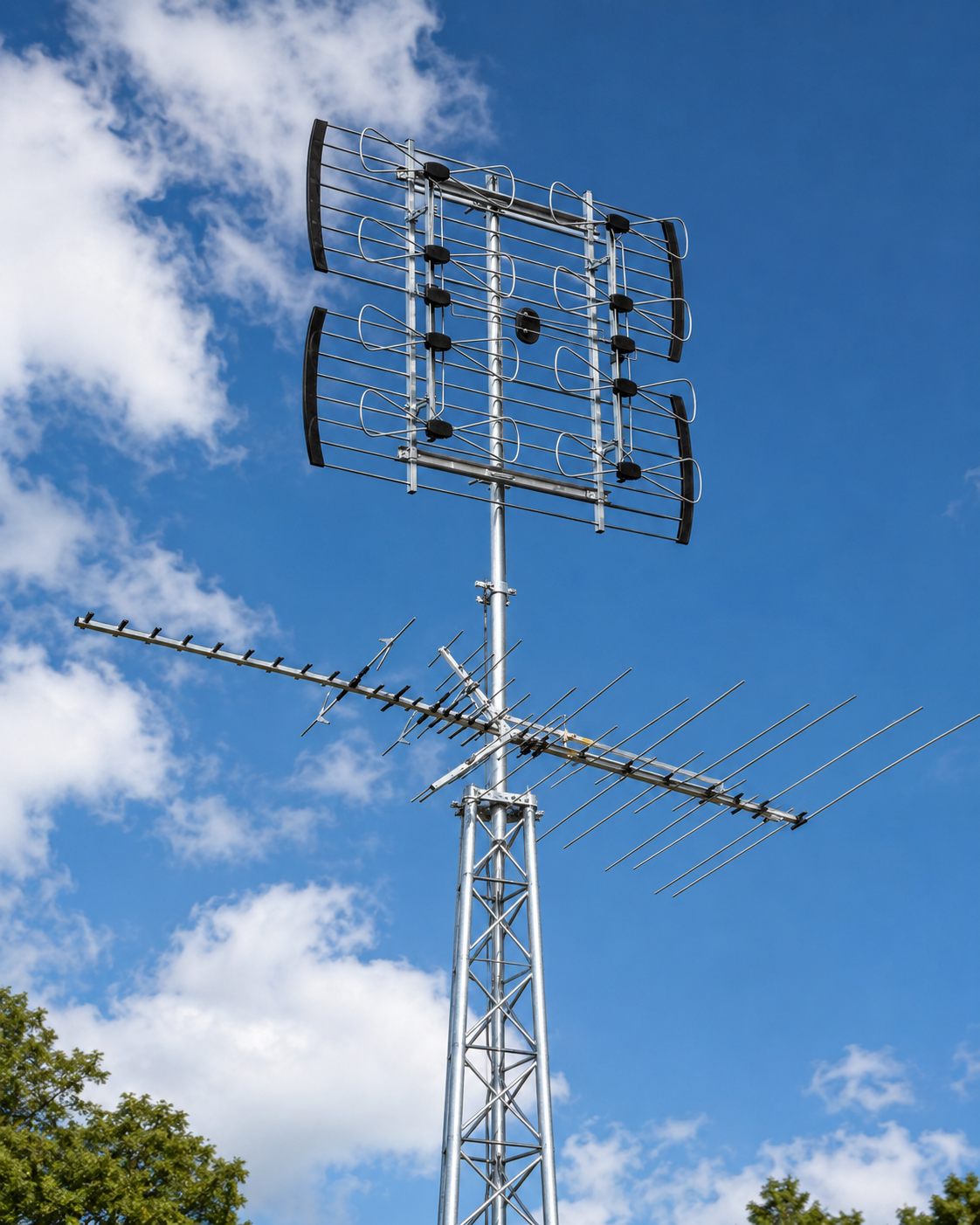
From affordable all-in-one antennas to high-gain tower systems, John’s Antennas explains how we match the antenna to the property, terrain, tower direction, reception needs, and budget.
Living in a rural area does not mean you have to settle for poor television reception or spend a fortune every month on cable, satellite, or expensive live-TV streaming packages.
With the right outdoor TV antenna, proper placement, and enough height, many Central Florida homeowners can receive ABC, CBS, NBC, FOX, PBS, and additional local broadcast channels free over the air while still keeping whatever streaming services they enjoy.
At John’s Antennas, we have been installing and servicing television antenna systems throughout Central Florida since 1983. More than four decades in the field have taught us one very important lesson:
There is no single “best” TV antenna for every home.
The right antenna depends on where you live, the transmitters available to you, tower direction, frequencies being used, terrain, surrounding trees and buildings, installation height, and your budget.
That is why we stock several different antenna designs instead of trying to make one antenna work everywhere.
Not sure what channels may be available at your home? Call John’s Antennas and let us review your location with you. We can discuss the television stations that may be available in your area, where the transmitters are located, and what type of antenna system may make sense for your property.
Height Can Be Just as Important as the Antenna
People often concentrate on the brand name or advertised range of an antenna. In rural reception, antenna height can be every bit as important as the antenna itself.
Trees, hills, buildings, and other obstructions can weaken, reflect, or distort television signals before they reach your antenna.
Sometimes moving an antenna another 10 feet higher can make a dramatic improvement because it helps clear nearby obstructions or places the antenna in a better signal path.
Additional height may result in:
- More available channels
- Less pixelation
- Fewer picture freezes and dropouts
- More dependable reception
- Better reception from distant broadcast markets
However, higher is not automatically better in every situation. Television signals can behave differently from one property to another, which is why we look at the entire reception environment rather than relying on one simple rule.
How Far Can a TV Antenna Really Reach?
Many antenna manufacturers and internet marketing companies advertise antennas as “50-mile,” “100-mile,” “150-mile,” or even longer-range antennas.
There is some value in these numbers as a very rough comparison within a manufacturer’s product line, but they should never be confused with a guaranteed reception distance.
Antennas are actually engineered and compared using specifications such as gain, frequency response, directivity, front-to-back ratio, and radiation pattern.
We are not aware of any standardized scientific formula that converts those antenna specifications into a universal mileage rating that will apply to every home.
Unfortunately, some of the extreme mileage claims found in consumer advertising are more of a sales pitch than a meaningful engineering specification.
A 150-mile sticker does not make an antenna a 150-mile antenna.
As a practical rule of thumb, we generally begin looking at conventional television reception within approximately 75 miles of the transmitting towers. That is not a hard limit. Reception can be better or worse depending on transmitter power, frequency, terrain, antenna height, atmospheric conditions, and obstacles between the viewer and the tower.
Broadcast stations can also use directional transmitting antenna patterns, concentrating more of their permitted signal toward the communities and marketplace they are designed to serve.
That means two homes located the same distance from a transmitter may have very different reception.
This is why we look at the actual transmitters, frequencies, terrain, tower direction, antenna gain, and available installation height instead of simply trusting a mileage number printed on a box.
Sky Blue Antennas — Built Florida Tough
Sky Blue antennas are an important part of our everyday antenna business and one of the primary antenna lines we install throughout Central Florida.
We like Sky Blue because the antennas provide strong performance in a durable design that works well in the heat, rain, wind, and severe weather conditions we encounter in Florida.
That is why we describe them to our customers as:
Built Florida Tough.
Different Sky Blue models allow us to match the antenna to the reception conditions at the property rather than installing more antenna than the customer needs.
Sky Blue SB22 — Our #1-Selling Sky Blue Antenna
Our number one selling Sky Blue antenna is the SB22.
We find that the SB22 works well for the majority of our residential customers because it provides an excellent balance of reception performance, size, and appearance.
It is especially popular in HOA and deed-restricted communities, where homeowners often want an effective outdoor antenna without installing something unnecessarily large or visually intrusive.
We still select the mounting location and antenna based on the actual reception conditions at the property, but for many Central Florida homes, the SB22 is an excellent fit.
Sky Blue SB48 — High-Gain UHF for One Market
For installations requiring higher-gain UHF reception from a single television market, we stock the Sky Blue SB48.
The SB48 is an 8-bay UHF antenna.
When the stations we want to receive are concentrated in one general direction, all eight bays can be aimed toward that market, allowing us to take advantage of the full UHF gain of the antenna.
We particularly like the SB48 when we need strong UHF performance from one market without moving up to a much larger traditional broadband antenna.
Winegard HD8200 — Our Largest Broadband Antenna
When we get into difficult rural reception and tower installations, the equipment becomes considerably larger.
The Winegard HD8200 is our largest broadband television antenna.
At roughly 14 feet long, it is normally used on an antenna tower rather than a typical residential roof mount because of its size and the type of installation for which we use it.
The HD8200 provides reception across:
Low VHF, FM, High VHF, and UHF.
One of the reasons we like the HD8200 is its broader reception pattern.
The way I often explain it to customers is:
“The HD8200 has wider peripheral vision.”
If several broadcast towers are spread out but are still located in the same general direction, the HD8200 can be a very useful antenna.
Instead of requiring extremely precise aiming at one transmitter location, its broader reception characteristics can make it a better choice when the stations are spread across part of the horizon.
Winegard HD7698 — When We Want to Aim More Precisely
The Winegard HD7698 is another large antenna that we normally use on towers.
Like the HD8200, it is approximately 14 feet long, but it performs a somewhat different job.
The HD7698 is a High-VHF/UHF antenna and is more sensitive to direction than the HD8200.
I explain the difference this way:
“The HD8200 has wider peripheral vision. The HD7698 looks more directly at the target.”
The HD7698 also provides higher UHF gain, which can make it an excellent choice when the broadcast transmitters are concentrated in one reasonably narrow direction.
A good example is aiming toward a transmitter group or antenna farm such as Jacksonville, where many of the stations may be located in approximately the same direction from the receiving property.
In that type of situation, the HD7698 lets us concentrate more precisely on the target area.
Building a Serious Tower-Mounted Antenna System
Sometimes one antenna is not enough to accomplish what the customer wants.
For a difficult rural location, we may combine antennas on the same tower.
For example, a large Winegard broadband antenna can be installed on the tower with a high-gain Sky Blue SB48 mounted several feet above it.
The result is a substantial antenna system that, when signal conditions call for it and matched with the appropriate high-gain preamplifier, lets us take advantage of different antenna characteristics for different portions of the television spectrum.
These are not installations we recommend simply because “bigger is better.”
They are systems we use when the reception problem actually justifies the equipment and tower height.
ClearStream 2 and ClearStream 4 — Performance Without the Traditional Antenna Look
Antennas Direct makes some extremely well-built antennas.
The ClearStream 2 and ClearStream 4 are particularly popular with homeowners because they do not look like traditional television antennas.
Their black circular figure-8 elements mounted in front of a reflector give them a much more contemporary appearance.
They are also very good UHF antennas.
Where we are more cautious is VHF reception. These smaller ClearStream designs do not, even with their optional VHF add-on kits, provide the same VHF gain as some of the larger traditional antennas we install.
For that reason, we particularly like them in areas approximately 15 to 25 miles from the transmitters, especially when the important stations are primarily on UHF.
They can be an excellent solution for customers who want good performance while keeping the antenna relatively small and attractive.
Receiving Stations From Two Different Directions
Central Florida creates some interesting reception situations.
Depending on the property, a customer may want television stations coming from the Orlando market as well as stations coming from Tampa.
An Antennas Direct 8-bay UHF system can give us another option.
The two 4-bay sections can be positioned independently. For example, one 4-bay section can be aimed toward Orlando while the other is aimed toward Tampa.
There is a tradeoff.
When an 8-bay antenna is divided between two directions, each market is effectively being served by one 4-bay section rather than having all eight bays concentrated toward a single market.
In simple terms:
Sky Blue SB48: full 8-bay UHF gain concentrated toward one market.
Split-direction 8-bay system: greater flexibility for two markets, with the antenna system divided between those directions.
If strong VHF reception is also required, we can add a dedicated VHF antenna to the same mast.
Systems like these can also be used as part of larger commercial-grade master antenna installations for nursing homes, campgrounds, assisted-living facilities, hospitality properties, and other locations serving multiple televisions.
LAVA HD-2605 Ultra — Our #1-Selling All-in-One Antenna
Not everyone needs—or wants—a large professional antenna system.
Sometimes the customer simply wants an inexpensive way to start receiving free over-the-air television.
That is where the LAVA HD-2605 Ultra earns its place.
At $69.95, the HD-2605 Ultra is our #1-selling all-in-one antenna.
We have sold thousands of them over the years, and customers continue to come back and ask for the LAVA by name.
The HD-2605 Ultra is particularly well suited for:
- Customers on a tight budget
- RV owners
- Temporary housing
- Seasonal residences
- People who are new to TV antennas
- Situations where an inexpensive all-in-one system makes more sense than a larger permanent installation
One of the strongest features of the HD-2605 Ultra is its G-3 control box.
Of the all-in-one antenna systems we have tested, we consider the G-3 one of the better control boxes we have used.
It includes adjustable gain control, built-in surge protection, and rotor control.
The antenna can be rotated from inside the home, which is useful when stations are located in different directions.
There is one important limitation.
The control box does not have a digital compass or direction readout. If precise aiming is required, it helps to have someone outside telling you which direction the antenna is actually pointing while the person inside operates the rotor.
The LAVA is not the antenna we would choose when maximum rural reception is required, but that does not make it a bad antenna.
For the right customer, it provides a tremendous amount of convenience for the money.
In fact, many customers who are new to antennas start with a LAVA. Once they experience free over-the-air television and decide they want stronger reception, more channels, or a more permanent outdoor system, they later upgrade to one of our Sky Blue antennas.
Other Antennas We Stock
John’s Antennas stocks additional models because every reception situation is different.
Our inventory includes products such as:
- Channel Master Digital Advantage 2020
- Channel Master Digital Advantage 3020
- LAVA 8000
- LAVA 8008
- Additional Antennas Direct products
- Additional Sky Blue antenna models
We do not believe the customer should have to know which antenna they need before calling us.
That is our job.
Thinking about purchasing a new antenna? Ask John’s Antennas about our current antenna equipment and installation specials.
More Channels and Less Pixelation Are the Real Goal
Ultimately, most customers are not interested in antenna theory.
They want their television to work.
A properly designed antenna system can provide:
More channels.
Less pixelation.
Fewer picture freezes.
More dependable local television.
And perhaps most importantly, an antenna gives homeowners another way to control their monthly television costs.
An outdoor antenna can provide local broadcast television without a monthly charge.
Customers can then choose the streaming services they actually want instead of purchasing an expensive television package simply to receive their local stations.
For many households, the combination of free local television from an antenna plus selected streaming services can provide more programming flexibility at a considerably lower monthly cost than traditional cable, satellite, or expensive live-TV streaming packages.
Already Have an Antenna? You May Not Need to Replace Everything
A poor-performing antenna system does not always need to be completely replaced.
John’s Antennas also repairs and upgrades existing antenna systems, including systems originally installed by someone else.
Depending on the problem, we may be able to improve reception by correcting antenna aim, repairing damaged coax or connectors, replacing failed components, changing the antenna, improving distribution within the home, or upgrading the mounting system.
We also service larger antenna and tower installations.
If you already own an antenna but are experiencing missing channels, pixelation, picture freezes, or unreliable reception, it may be worth having the existing system evaluated before purchasing everything again.
The Goal Is the Right Antenna — Not the Biggest Antenna
One of the biggest mistakes people make is buying an antenna based entirely on an advertised mileage rating or simply choosing the biggest antenna they can find.
Neither approach guarantees better television reception.
Trees matter.
Terrain matters.
Tower direction matters.
Broadcast frequency matters.
Antenna gain matters.
Cable and splitter losses matter.
And antenna height can matter tremendously.
That is why two houses only a few miles apart can require completely different antenna systems.
At John’s Antennas, we look at the reception problem first and select the equipment second.
Sometimes the right answer is an inexpensive LAVA.
Sometimes it is a Sky Blue SB22 mounted discreetly on a home in an HOA community.
Sometimes it is a ClearStream antenna because the customer wants something smaller and attractive.
Sometimes it is a high-gain SB48.
And sometimes the answer is a tower carrying a 14-foot Winegard antenna with another high-gain antenna mounted above it.
The goal is not to install the biggest antenna.
The goal is to install the right antenna for the job.
Professional TV Antenna Installation in Central Florida
John’s Antennas has served Central Florida since 1983.
We install, repair, and upgrade television antenna systems throughout the region, from straightforward residential installations to rural high-gain and tower-mounted antenna systems.
We serve homeowners and businesses throughout Ocala, The Villages, Leesburg, Clermont, Mount Dora, Brooksville, Spring Hill, Inverness, Crystal River, Chiefland, Williston, Dade City, Zephyrhills, Palatka, Gainesville-area communities, and surrounding parts of Central Florida.
If you are considering a new antenna, call John’s Antennas and let us review your location and discuss what channels may be available, along with current antenna and installation specials.
If you already have an antenna, we can also evaluate your existing system and discuss repair or upgrade options.
More channels. Better reception. Lower monthly television costs.
That is what a properly designed antenna system is supposed to deliver.
Frequently Asked Questions
What is the best TV antenna for a rural home?
There is no single antenna that is best for every rural property. The correct antenna depends on transmitter location, tower direction, terrain, trees, frequencies being used, installation height, and the channels the customer wants to receive. John’s Antennas stocks several antenna designs so the equipment can be matched to the property.
Are TV antenna mileage ratings accurate?
They should be considered rough marketing guides, not guaranteed reception distances. Antennas are actually evaluated using specifications such as gain, frequency response, and radiation pattern. Real-world reception also depends on transmitter power and direction, terrain, antenna height, trees, buildings, and other conditions between the antenna and the tower.
How far away can I receive a television station?
There is no single distance that applies to every station or every property. As a practical rule of thumb, John’s Antennas generally begins evaluating conventional antenna reception within approximately 75 miles of the transmitting towers. Some locations may receive farther stations, while others may have difficulty with much closer transmitters because of terrain, obstructions, transmitter patterns, or other conditions.
Does mounting a TV antenna higher improve reception?
Often it does. Additional height can help an antenna clear trees, buildings, and other nearby obstructions. On some rural properties, another 10 feet of height can make a significant difference. However, every location is different, so height should be evaluated along with antenna type, tower direction, terrain, and frequency.
Can I use a TV antenna and streaming services together?
Absolutely. Many of our customers use an antenna for free local broadcast channels while keeping selected streaming services for movies, sports, specialty programming, and other entertainment.
Do I need an expensive antenna to get started?
Not necessarily. Our #1-selling all-in-one antenna, the LAVA HD-2605 Ultra, sells for $69.95 and is popular with customers who want an economical way to start receiving over-the-air television. Customers who later want stronger reception or a more permanent system can upgrade to a larger antenna.
Can John’s Antennas repair an antenna someone else installed?
Yes. We repair and upgrade existing television antenna systems, including systems installed by other companies or by homeowners. Depending on the problem, the solution may involve the antenna, coax, connectors, amplifiers, splitters, mounting hardware, tower equipment, or other parts of the system.
How can I find out what local channels may be available at my home?
Call John’s Antennas and we can review your location with you. We can discuss the television stations that may be available in your area, where the transmitters are located, and the type of antenna system that may be appropriate for your property. Actual reception depends on the antenna, installation height, terrain, trees, transmitter characteristics, and other site conditions.