Point-to-Point Wireless Internet for Rural Properties
Extend Starlink, cable, or fiber internet from your home to a barn, workshop, office, or other building without trenching hundreds of feet for cable.
What Is Point-to-Point Wireless Internet for Rural Properties?
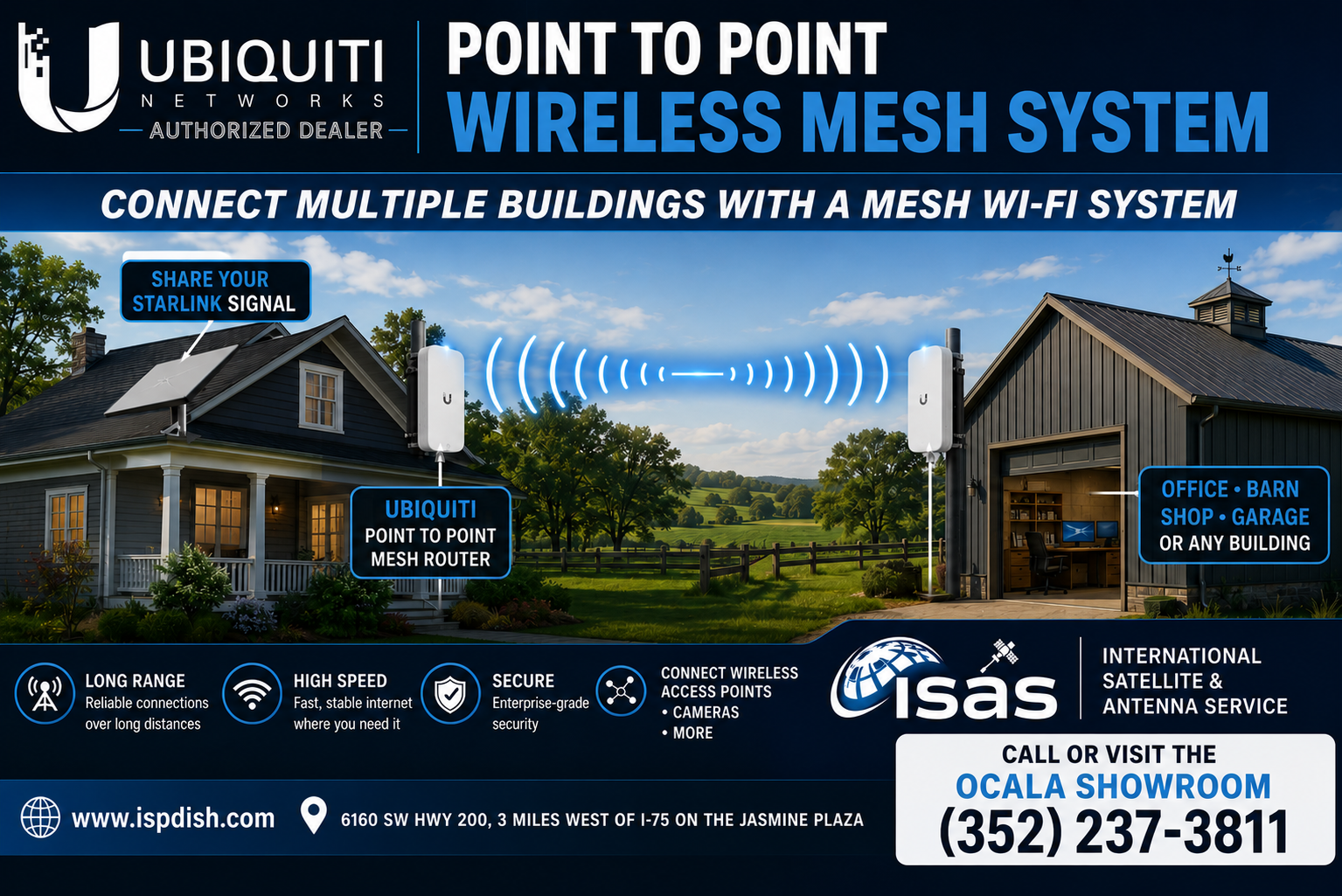
Point-to-point wireless internet connects two buildings using a pair of outdoor directional radios. It is very different from a normal Wi-Fi extender.
One radio connects to the internet at the main building and sends the connection wirelessly to a second radio at the remote building. From there, a Wi-Fi access point can provide internet coverage inside the barn, workshop, office, guest house or other building.
This is especially useful on rural properties where Starlink, cable or fiber internet is available at the house, but another building may be hundreds of feet away.
Instead of trenching across the property to install cable, a properly designed wireless bridge can carry the internet connection between the buildings through the air.
John's Antennas has served Central Florida since 1983. Today we design and install point-to-point wireless systems for homes, farms, horse properties, workshops and small businesses.
Line of Sight Is Important
One of the most important parts of a point-to-point wireless system is having a clear path between the two radios.
Trees, buildings, hills and other obstacles can weaken or completely block the wireless link.
However, simply being able to see the other building does not always mean the path is completely clear.
Wireless signals also use an area around the direct path called the Fresnel zone. Think of it as an invisible football-shaped area surrounding the signal between the two radios. Trees, rooftops or even the ground entering this area can reduce performance.
That is why we evaluate the property before deciding where the radios should be mounted.
Sometimes raising a radio only a few feet can make a substantial difference.
What Equipment Is Used?
A typical point-to-point system may include:
- Two directional outdoor wireless radios
- Mounting brackets or poles
- Outdoor-rated Ethernet cable
- PoE power supplies or injectors
- Surge protection and grounding
- A network switch when required
- A Wi-Fi access point at the remote building
We commonly use professional equipment such as Ubiquiti NanoBeam and similar Ubiquiti wireless products, depending on the requirements of the property.
There is no single radio or antenna that is right for every installation.
From the Main Building to the Barn or Workshop
At the building with the internet connection, the first radio is connected to the network and mounted where it has a clear path toward the remote building.
A second radio is installed at the other end and carefully aligned with the first.
Ethernet cable connects the radio to the network equipment inside each building. Power over Ethernet, commonly called PoE, allows power and data to travel through the Ethernet cable so electrical power does not have to be installed at the outdoor radio itself.
Once the wireless bridge is operating, a separate Wi-Fi access point can provide coverage inside the remote building.
For example:
Starlink at House → Point-to-Point Radio → Wireless Link → Radio at Barn → Wi-Fi Access Point
The same concept can be used with cable, fiber or other internet services.
Metal Buildings Need Special Consideration
Many barns, workshops and agricultural buildings in Central Florida are constructed with metal siding or metal roofs.
Metal can significantly reduce Wi-Fi signals.
For that reason, receiving a strong point-to-point signal at the outside of the building does not necessarily mean you will have good Wi-Fi coverage inside.
We normally design the remote side of the system with its own properly located Wi-Fi access point.
Depending on the property, an additional outdoor access point can also provide Wi-Fi around a horse arena, equipment yard, patio or other outdoor area.
What Affects Performance?
Several things can affect the reliability of a wireless bridge:
Trees: Heavy foliage can block the signal, and trees continue growing after the installation.
Terrain: A hill or change in elevation can obstruct the path.
Distance: Longer links require more careful system design and alignment.
Mounting height: Sometimes height is more important than distance.
Internet speed: A wireless bridge cannot create bandwidth that is not available from the original internet connection.
Building construction: Metal, concrete and other materials can affect Wi-Fi coverage inside the remote building.
DIY or Professional Installation?
A simple wireless bridge across a short, completely open area can sometimes be installed by an experienced do-it-yourselfer.
More difficult installations require careful planning.
Professional installation becomes particularly valuable when the system involves trees, long distances, elevated mounting locations, towers, lightning exposure or multiple buildings.
A professional installation should include proper radio alignment, weatherproof cable connections, secure mounting, appropriate grounding and surge protection, and testing after the system is completed.
Never climb a tower or work from a dangerous roof location without the proper equipment and training.
Can Point-to-Point Wireless Work With Starlink?
Yes.
This is one of the applications we see regularly in rural Central Florida.
You may have an excellent Starlink connection at the main house but need internet at a barn, detached garage, workshop, office or other building.
Instead of purchasing another internet service, we may be able to distribute the existing Starlink connection across the property using a point-to-point wireless bridge.
The design depends on the distance, terrain, trees and the internet coverage you need at the remote location.
Frequently Asked Questions
How is a wireless bridge different from a Wi-Fi extender?
A Wi-Fi extender receives an existing Wi-Fi signal and rebroadcasts it. A point-to-point bridge uses two dedicated directional radios to create a wireless connection between two locations.
The remote building can then have its own Wi-Fi access point.
Can trees block a point-to-point wireless signal?
Yes. Trees and heavy foliage can weaken or block the signal. Even branches entering the Fresnel zone can affect performance.
How far can a wireless bridge work?
There is no single answer. Distance, equipment, mounting height, terrain, trees and interference all affect the design. Some installations may only cover a few hundred feet while professionally designed systems can operate over much greater distances when conditions are right.
Can I send Starlink internet to my barn?
In many cases, yes. If there is a suitable wireless path between the buildings, a point-to-point bridge can extend your existing Starlink network to a barn, workshop, guest house or other structure.
Need Internet in Another Building?
Getting internet to a second building does not always require digging a trench or purchasing another internet service.
John's Antennas has been serving Central Florida since 1983. We can evaluate your property, determine whether a wireless bridge will work, and design the appropriate point-to-point system for your home, farm or business.
Contact John's Antennas to schedule a site evaluation.