TV Antenna Signal Boosters: Do You Need One?
This is a subtitle for your new post
TV Antenna Signal Boosters: Do You Need One?
Learn when an antenna amplifier can improve reception—and when it may make pixelation, missing channels, and interference worse.
Last Updated: September 22, 2026
A TV antenna signal booster can improve reception under the right conditions, but more amplification isn't always the answer.
An amplifier can help compensate for signal loss caused by long coaxial cable runs, splitters, and multiple television outlets. However, it cannot create a television signal the antenna isn't receiving, and it can't fix every reception problem.
In some installations, using too much amplification can overload the amplifier or television tuner and make reception worse. Before buying a booster, understand whether the problem is weak signal strength, poor signal quality, antenna placement, a damaged cable, interference, or something else.
What Does a TV Antenna Signal Booster Do?
A TV antenna signal booster—more accurately called an antenna amplifier—increases the strength of television signals traveling through the antenna system.
When properly selected and installed, an amplifier may help reduce:
- Picture pixelation
- Picture freezing
- Audio dropouts
- Missing channels
- Signal loss through long coaxial cables
- Signal loss caused by splitters
- Reception problems when serving multiple televisions
An amplifier does not improve the quality of the signal arriving at the antenna. It strengthens the signal along with any noise or interference already present.
That is why the antenna must first receive a usable signal. If the antenna receives little or no signal from a station, an amplifier cannot create that station.
Pro Tip: An amplifier works best when the antenna receives a usable signal that is being weakened by cable length, splitters, or multiple television outlets.
Signal Strength and Signal Quality Are Not the Same
Signal strength measures how powerful the received signal is. Signal quality measures how clean and usable that signal is.
An amplifier can increase signal strength, but it cannot always improve signal quality.
For example, a signal may already be strong but suffer from multipath interference caused by reflections from buildings, hills, metal structures, or other objects. Amplifying that distorted signal may make it stronger without making it more reliable.
This is one reason a professional diagnosis is valuable. The symptoms you see on television do not always reveal the true cause of the reception problem.
When Can a TV Antenna Amplifier Help?
An amplifier may be beneficial when:
- The antenna receives weak but usable signals
- The coaxial cable run is unusually long
- The signal is divided among several televisions
- Splitters are causing measurable signal loss
- The home is located farther from the desired broadcast towers
- The antenna system loses channels after additional outlets are connected
- A mast-mounted preamplifier is needed to overcome cable loss between the antenna and the house
Distance from the broadcast towers is only one factor. Terrain, antenna height, trees, buildings, transmitter power, channel frequency, cable condition, and nearby strong stations can all affect reception.
Match an amplifier to the property's conditions. Installing the most powerful amplifier available is not necessarily the best solution.
When Will an Amplifier Not Help?
An amplifier usually will not correct reception problems caused by:
- An antenna that is too small or unsuitable for the location
- Incorrect antenna aiming
- Severe terrain or structural obstructions
- Multipath interference
- Damaged or water-filled coaxial cable
- Corroded connectors
- Loose connections
- Improperly installed splitters
- Electrical noise entering the antenna system
- A station that is not being received at the antenna
- An overloaded tuner or amplifier
When signals are already strong, adding an amplifier may cause overload. This can cause pixelation, intermittent reception, or channels to disappear entirely.
What Is a Smart Antenna Amplifier?
Some Televes amplifiers use intelligent signal-processing technology to automatically regulate amplification based on the incoming signal levels.
Instead of operating at maximum amplification under every condition, the amplifier adjusts its gain to help maintain suitable output levels. This can reduce the possibility of weak signals being under-amplified or stronger signals causing overload.
This technology can be especially useful in Central Florida, where an antenna may receive a mixture of weak, moderate, and strong television signals.
Depending on the Televes model, available features may include:
- Intelligent or automatic gain regulation
- Low-noise amplification
- Built-in 4G and 5G LTE filtering
- Protection against excessive incoming signal levels
- Surge-protection circuitry
- Weather-resistant construction for outdoor installation
Built-in LTE filtering helps prevent nearby cellular signals from entering the amplifier and contributing to interference or overload.
Surge-protection circuitry provides an additional layer of protection for the amplifier. However, it does not replace proper antenna-mast and coaxial-cable grounding in accordance with applicable electrical codes.
Even an intelligent amplifier cannot create a signal that the antenna does not receive. It also cannot correct the wrong antenna, poor aiming, severe obstructions, damaged coaxial cable, or multipath interference.
Televes Smart Amplifiers and Channel Master Preamplifiers
John’s Antennas features professional-quality Televes smart amplifiers and Channel Master preamplifiers.
Channel Master offers preamplifiers with different gain levels, allowing you to match the equipment to your reception conditions rather than automatically installing the strongest available model.
Televes offers intelligent amplification technology designed to regulate gain and help maintain appropriate signal levels. Some models also include built-in cellular filtering and extra protective features.
The best choice depends on:
- Signal strength and quality at the antenna
- Distance and direction of the desired stations
- Cable length
- Number of televisions
- Splitter losses
- Nearby strong stations
- Cellular interference
- Antenna type and mounting location
John’s Antennas evaluates the complete antenna system before recommending an amplifier. The correct solution might be a Televes smart amplifier, a Channel Master preamplifier, a distribution amplifier, an antenna adjustment—or no amplifier at all.
View Our Mast-Mounted Preamplifiers →
Preamplifier Versus Distribution Amplifier
A preamplifier and a distribution amplifier serve different purposes.
Mast-Mounted Preamplifier
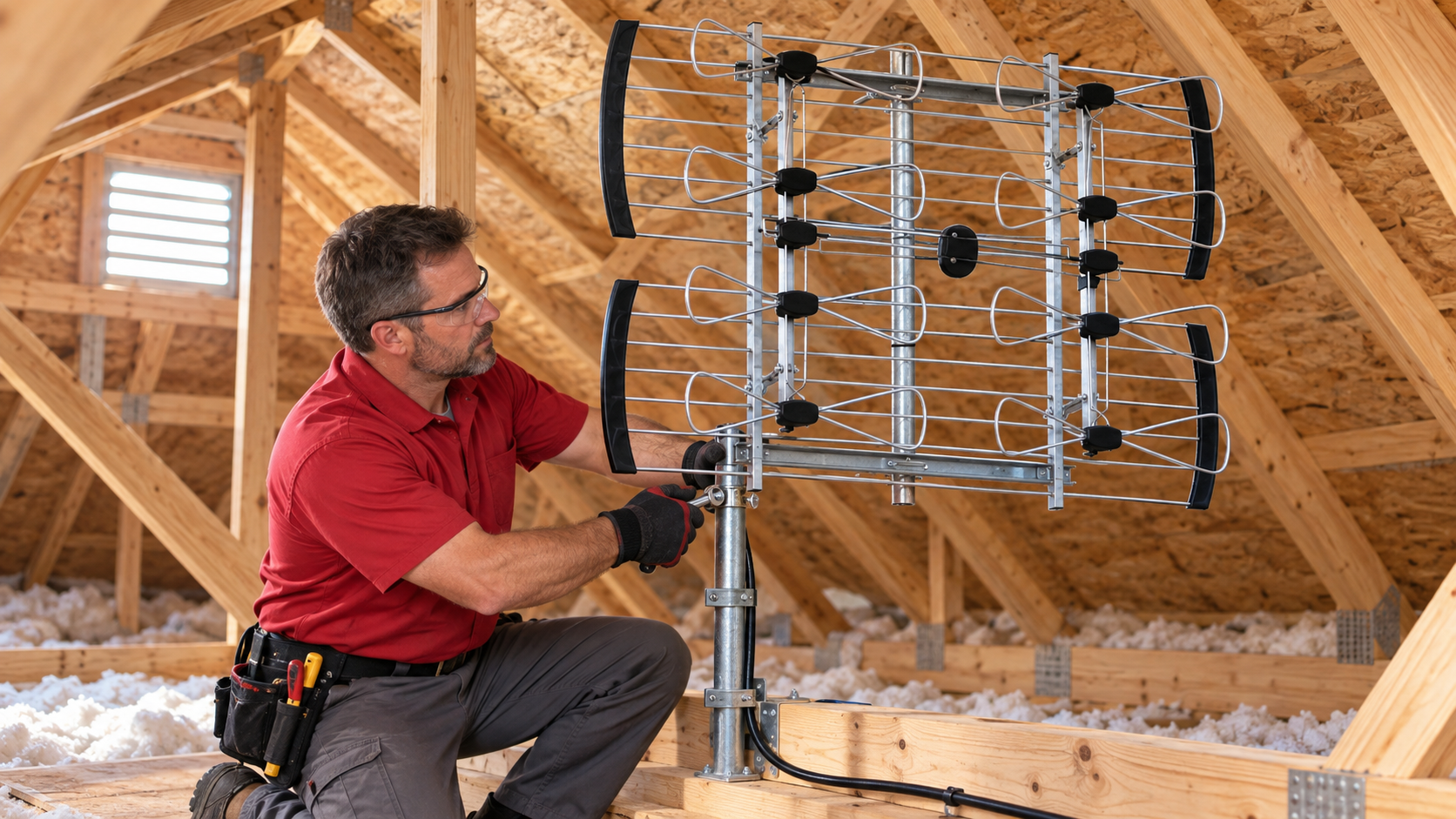
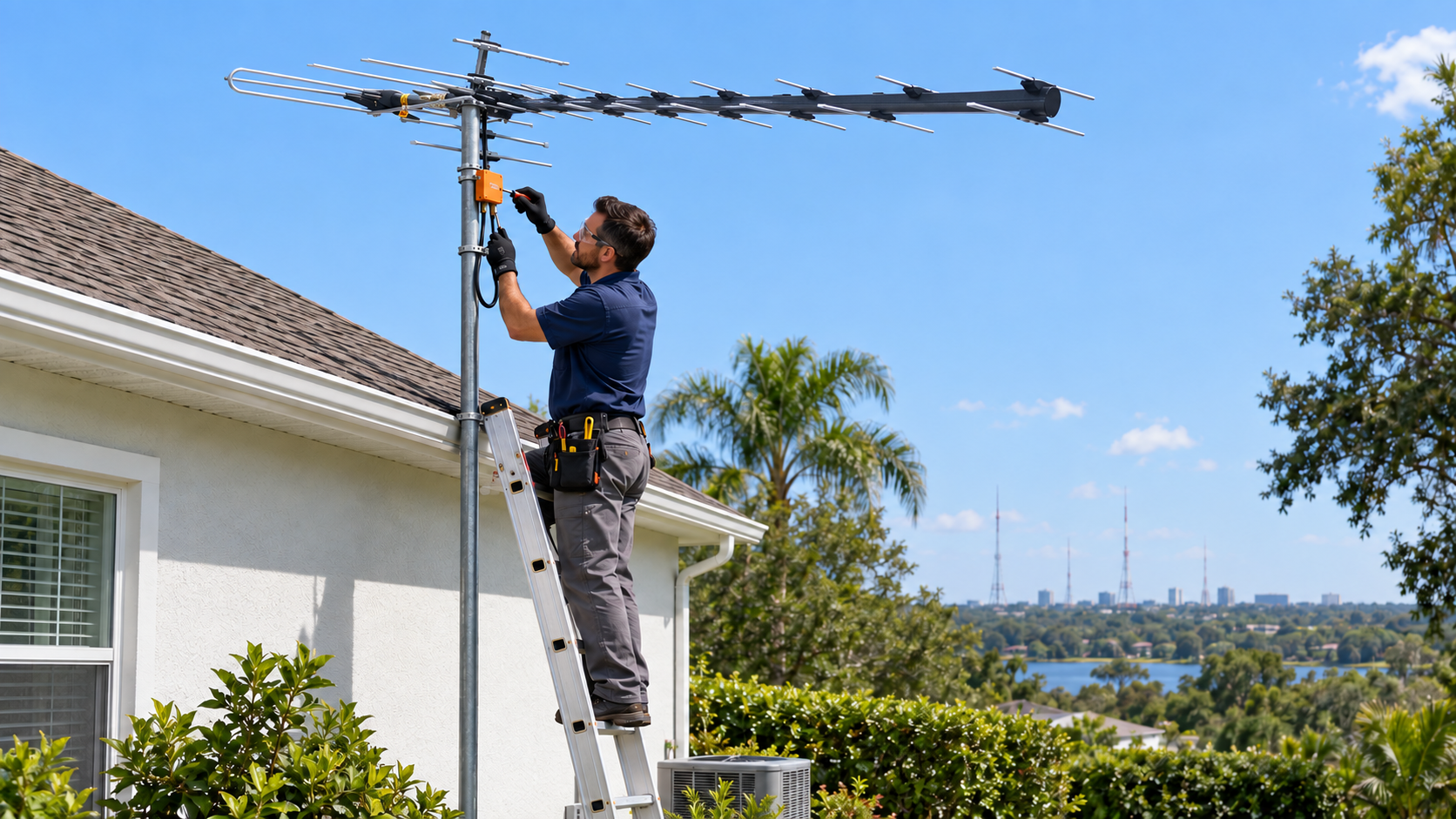
A preamplifier is installed close to the antenna to strengthen the received signal before it travels through the coaxial cable.
Preamplifiers are commonly used when:
- Signals at the antenna are weak
- The cable run from the antenna is long
- Signal loss occurs before the cable reaches the television or splitter
- The antenna serves several outlets after a long downlead
Installing the preamplifier close to the antenna helps overcome signal loss that occurs farther down the cable.
Distribution Amplifier
A distribution amplifier is normally installed indoors and compensates for losses caused by splitters and multiple television outlets.
It may be appropriate when:
- The signal arriving inside the home is already adequate
- Several televisions must be connected
- Reception becomes weaker after adding a splitter
- Different cable runs serve multiple rooms
Don't use a distribution amplifier to compensate for a signal that is already poor when it reaches the house.
How to Troubleshoot Weak TV Antenna Reception
Before installing an amplifier, examine the complete antenna system.
1. Check Which Channels Are Affected
If only one station is having trouble, the problem may involve that station’s frequency, transmitter location, antenna pattern, or signal path.
If every channel is affected, the problem is more likely related to the antenna, cable, power supply, splitter, or connections.
2. Inspect the Coaxial Cable
Look for:
- Cracks or cuts in the cable
- Sharp bends or pinched sections
- Loose connectors
- Corrosion
- Water intrusion
- Poorly installed fittings
- Unnecessary splitters or couplers
A booster cannot repair a damaged cable or corroded connection.
3. Verify Antenna Position and Aiming
Small changes in antenna height, direction, or location can make a major difference.
Trees, metal roofs, nearby buildings, hills, and other obstructions can absorb, reflect, or scatter television signals. In many cases, repositioning the antenna produces better results than adding more amplification.
4. Check the Amplifier’s Power Supply
Most mast-mounted preamplifiers receive power through the coaxial cable from an indoor power inserter. If that power supply is disconnected, plugged into a switched outlet, installed backward, or has failed, reception may suddenly become much worse.
5. Test Without the Amplifier
If practical, temporarily bypassing the amplifier can help determine whether it is improving reception, causing overload, or has failed.
Leave testing outdoor or tower-mounted equipment to a qualified professional.
Safety Warning: Do not climb onto a roof or antenna tower to troubleshoot reception. Falls and contact with overhead electrical lines can cause serious injury or death.
Common Causes of TV Signal Interference
Reception problems can have many causes beyond weak signal strength.
Multipath Interference
Multipath occurs when a television signal reflects from buildings, hills, water, or other objects and arrives at the antenna along more than one path.
An amplifier generally cannot correct multipath interference. Repositioning, raising, lowering, or changing the antenna may work better.
Electrical Noise
LED light bulbs, inexpensive power supplies, motors, poorly shielded electronics, and damaged electrical equipment can generate interference.
Turning suspect devices off temporarily may help identify the source.
Cellular Interference
Strong nearby 4G and 5G LTE signals can enter certain antenna systems and contribute to amplifier overload or interference. An appropriate LTE filter—or an amplifier with filtering built in—may help.
Excessive Amplification
Too much gain can overload the amplifier or television tuner. The result may look like weak reception even though the actual problem is excessive signal strength.
This is why the strongest booster is not always the best booster.
Professional TV Antenna Diagnosis in Central Florida
Weak TV antenna reception does not automatically mean you need a signal booster.
The problem may be the antenna, its mounting location, aiming, coaxial cable, connectors, splitters, interference, amplifier power supply, or an improper amplifier. Adding another booster without diagnosing the system can make the problem more difficult to locate.
John’s Antennas has served Central Florida since 1983. We can evaluate your antenna system, identify the likely cause of reception problems, and recommend the appropriate Televes or Channel Master equipment when amplification is needed.
We provide professional TV antenna installation, reception troubleshooting, amplifier replacement, cable repair, and antenna-system upgrades for homes and businesses throughout our Central Florida service area.
Not Sure Whether You Need a Signal Booster?
A TV antenna amplifier can be a valuable part of a properly designed reception system—but only when it addresses the actual source of the signal loss. Installing the wrong amplifier, or simply choosing the model with the highest gain, can make reception worse instead of better.
John’s Antennas has served Central Florida since 1983. We evaluate the complete antenna system—including the antenna, aiming, signal conditions, coaxial cable, connectors, splitters, and television outlets—before recommending additional amplification.
When you need an amplifier, we install professional-quality Televes smart amplifiers and Channel Master preamplifiers, selected to match your property's conditions.
If you are experiencing pixelation, missing channels, picture freezing, or unreliable reception, let us help determine whether you need an amplifier, an antenna adjustment, a cable repair, or another solution.
Frequently Asked Questions
Do TV antenna signal boosters actually work?
Yes. An antenna amplifier can help when the antenna receives a usable signal that is being weakened by long coaxial cable runs, splitters, or multiple television outlets.
An amplifier cannot create a signal the antenna does not receive, and it cannot correct every interference or antenna-placement problem.
Can an antenna amplifier make reception worse?
Yes. Excessive amplification can overload the amplifier or television tuner. This may cause pixelation, picture freezing, intermittent reception, or missing channels.
An amplifier should be selected according to the signal conditions rather than simply choosing the model with the highest advertised gain.
What is the difference between a preamplifier and a distribution amplifier?
A preamplifier is installed near the antenna to strengthen signals before they travel through the coaxial cable.
A distribution amplifier is usually installed indoors to compensate for losses caused by splitters and multiple television outlets.
Where should a TV antenna preamplifier be installed?
The outdoor portion of a mast-mounted preamplifier should normally be installed as close to the antenna as practical. This allows the signal to be amplified before it experiences loss through the coaxial cable.
The power supply or power inserter is generally installed indoors and sends operating power to the preamplifier through the coaxial cable.
What does a Televes smart amplifier do?
Depending on the model, a Televes smart amplifier can automatically regulate gain based on incoming signal conditions. Certain models may also include low-noise amplification, 4G and 5G LTE filtering, overload protection, and surge-protection circuitry.
The technology helps maintain more suitable output levels, but it cannot recover a station the antenna is not receiving.
Does an LTE filter improve TV antenna reception?
An LTE filter may help when strong cellular signals are entering the antenna system and contributing to interference or amplifier overload.
It will not improve reception when the actual problem is poor antenna placement, damaged coaxial cable, incorrect aiming, or an extremely weak television signal.
Do I need an amplifier when connecting multiple TVs?
Possibly. Every splitter introduces signal loss. A distribution amplifier may compensate for that loss when one antenna serves several televisions.
However, the incoming signal should be evaluated first. If the signal is already weak or distorted before it reaches the splitter, a different solution may be necessary.
Does built-in surge protection replace antenna grounding?
No. Surge-protection circuitry can provide an additional layer of equipment protection, but it does not replace proper grounding of the antenna mast and coaxial cable in accordance with applicable electrical codes.
Should I install the strongest amplifier available?
No. More gain is not always better. An excessively powerful amplifier can overload the system and cause worse reception.
The amplifier should be selected based on measured or observed signal conditions, cable loss, splitter loss, and the number of television outlets.