Will Outdoor Antennas Work Through Trees? What to Know
Will Outdoor Antennas Work Through Trees? What to Know
How to Combine Antenna and Streaming Services in 2026
JP
John Pearce· Content Writer
Sep 11, 2026
6 min read1,176 words
How Trees Block Outdoor TV Signals
Yes, outdoor TV antennas can work through trees, but foliage can weaken and distort the signal before it reaches the antenna. The important question is whether enough clean signal reaches the antenna for your TV tuner to decode it reliably.
Signal attenuation is the loss of signal strength as a radio wave travels through or around obstacles. Trees can absorb, scatter, and reflect television signals, and the effect can become worse when foliage is dense or wet.
UHF television signals are generally more affected by foliage than lower-frequency VHF signals. That is one reason a channel that works reliably during the winter may become less stable when trees fill out during spring and summer.
Key Takeaway: Trees do not automatically prevent TV antenna reception, but a heavy tree line can reduce signal strength and signal quality enough to cause pixelation, dropouts, or missing channels. The goal is to find the antenna position that receives the strongest, cleanest signal possible.
TV Antenna Height and Signal Amplifiers
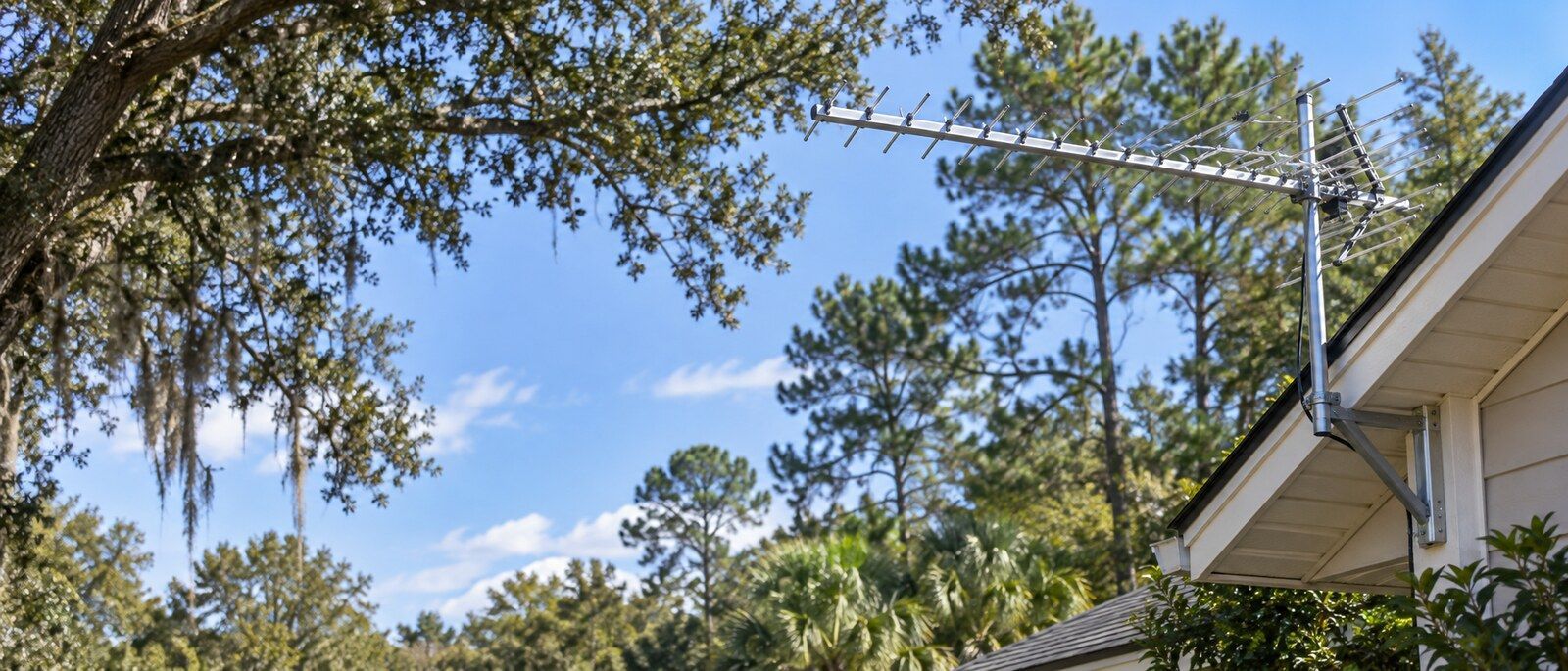
Height can make a major difference on properties surrounded by trees. There is no single correct antenna height for every home. The best location depends on the broadcast tower direction, distance, terrain, tree coverage, antenna design, and nearby structures.
Sometimes moving an antenna only a few feet higher—or several feet to one side—can place it in a much better signal path. On heavily wooded properties, a taller mast or antenna tower may be necessary to get above part of the tree canopy.
A mast-mounted preamplifier can also help, but only when there is already a usable signal at the antenna. A preamplifier is most useful for compensating for signal loss that occurs after the antenna, such as loss through a long coaxial cable run or multiple splitters.
Amplification should not be the first solution. If the antenna is receiving a poor-quality signal because of trees, terrain, interference, or incorrect aiming, an amplifier cannot recreate the information that has already been lost.
Can a Signal Amplifier Fix Tree Interference?
Sometimes—but not by itself.
A preamplifier can help preserve a marginal but usable signal as it travels through coaxial cable and splitters. It cannot replace signal that never reached the antenna in the first place.
The proper order is:
Antenna selection and placement first. Aiming and height second. Amplification only when needed.
Too much amplification can also cause problems. Strong local stations or other nearby signals can overload an amplifier or television tuner and actually make reception worse.
That is why professional signal measurements are useful. Rather than simply adding a larger antenna or stronger amplifier, a technician can determine whether the real problem is foliage, terrain, antenna location, cable loss, interference, or a combination of several factors.
When to Call a Professional
Tree interference is common in heavily wooded areas and can often be improved with the right antenna location, mounting height, aiming, and equipment. The challenge is determining whether the real problem is trees, terrain, distance from the broadcast towers, cable loss, equipment failure, or a combination of several factors.
John's Antennas installs, repairs, and troubleshoots outdoor TV antenna systems throughout Central Florida. We can evaluate the trees and terrain around your property, check the direction and distance of available broadcast stations, and test the existing antenna system to determine the best solution.
If surrounding trees are too tall for a standard mast, a TV Antenna Tower may provide the additional height needed to reach a better signal path. Professional TV Antenna Installation also helps ensure that the antenna is properly mounted, aimed, grounded, and connected.
Call John's Antennas for a professional evaluation before spending money on larger antennas, stronger amplifiers, or unnecessary equipment.
Frequently Asked Questions
Do trees interfere with outdoor TV antennas?
Yes, trees can block or weaken TV signals, especially when they sit between your antenna and the broadcast tower. Leaves, branches, and trunks absorb and scatter signal energy, causing pixelation, dropouts, or lost channels. The effect depends on tree density, distance, and whether the trees are in the direct transmission path. In Central Florida, thick oak canopies are a common cause of poor reception. A professional evaluation can confirm whether trees are the problem and what fixes will help.
Can a signal booster help if trees are blocking my antenna?
An antenna signal booster can help when trees weaken the signal but some usable signal still reaches the antenna. It amplifies what is there, which can restore marginal channels and reduce dropouts. However, a booster cannot create a signal that is completely blocked. If trees fully block line-of-sight, the better fix is to relocate or raise the antenna first, then add a booster if needed. A professional can test signal strength before and after to confirm the right approach.
Is it better to mount an antenna higher to clear tree lines?
Raising the antenna is often the most effective way to get above tree obstruction and improve line-of-sight to the broadcast tower. Even a few extra feet can make a difference when branches are the main blocker. That said, higher mounting means more wind load and a longer mast, so a professional should do it safely. In many Central Florida homes, a properly height-matched mast combined with the right antenna solves tree-related reception problems without risky DIY climbing.
Contact John's Antennas to discuss your location and antenna options.
Serving Central Florida since 1983.
Reception Disclaimer: Over-the-air television reception varies by location and can be affected by distance from broadcast towers, terrain, trees, buildings, weather conditions, antenna height and placement, equipment, wiring, and other factors. References to networks or channels are examples only and do not guarantee that any particular station or number of channels will be available at a specific property.